How to Build Scalable Video Production That Actually Works Long-Term
Learn how to scale video production without sacrificing quality or budget. Practical strategies for creating consistent streams of content across platforms.
You need more videos than your team can make.
Your marketing calendar demands 30 or 50 videos every month. But your current setup takes two weeks per video. The math does not work.
Most teams hit the same wall. They hire more people, spend more money, or lower their quality standards. None of these options solve the real problem.
Scalable video production means you can make more videos without spending more time or money for each one. This guide shows you where traditional video production breaks down and how to build a system that grows with your needs.
No hype. Just practical steps.
Key Takeaways
Traditional Production Fails: Most video production costs $2,000 to $10,000 per video and takes 2 to 4 weeks, which does not scale because every video needs the same work from scratch. Recent production benchmarks show that live‑action marketing videos commonly range from around $2,000 on the low end to $50,000 or more for higher‑end campaigns, depending on complexity and length.
Building In-House Takes Time: Plan for 6 to 12 months and budget $250,000 to $500,000 before you reach true scale
Scale Needs Systems: Reusable templates, trained assets, and parallel workflows cut costs per video while maintaining brand consistency
Creative Partners Enable Volume: Built specifically to solve the scale problem with finished videos delivered in 24 to 72 hours
Quality Stays Consistent: Systems and clear guidelines protect quality better than individual effort across high volumes
Partner vs Build Decision: Build in-house if you have 12 months and $300,000+ budget, or partner when you need 20 to 100+ videos monthly
Why Traditional Video Production Can't Scale (The Bottleneck Problem)
Traditional video production follows a simple rule. More videos equal more time, more money, and more people. This linear cost model works fine when you need one or two videos. It breaks when you need 30 or 50.
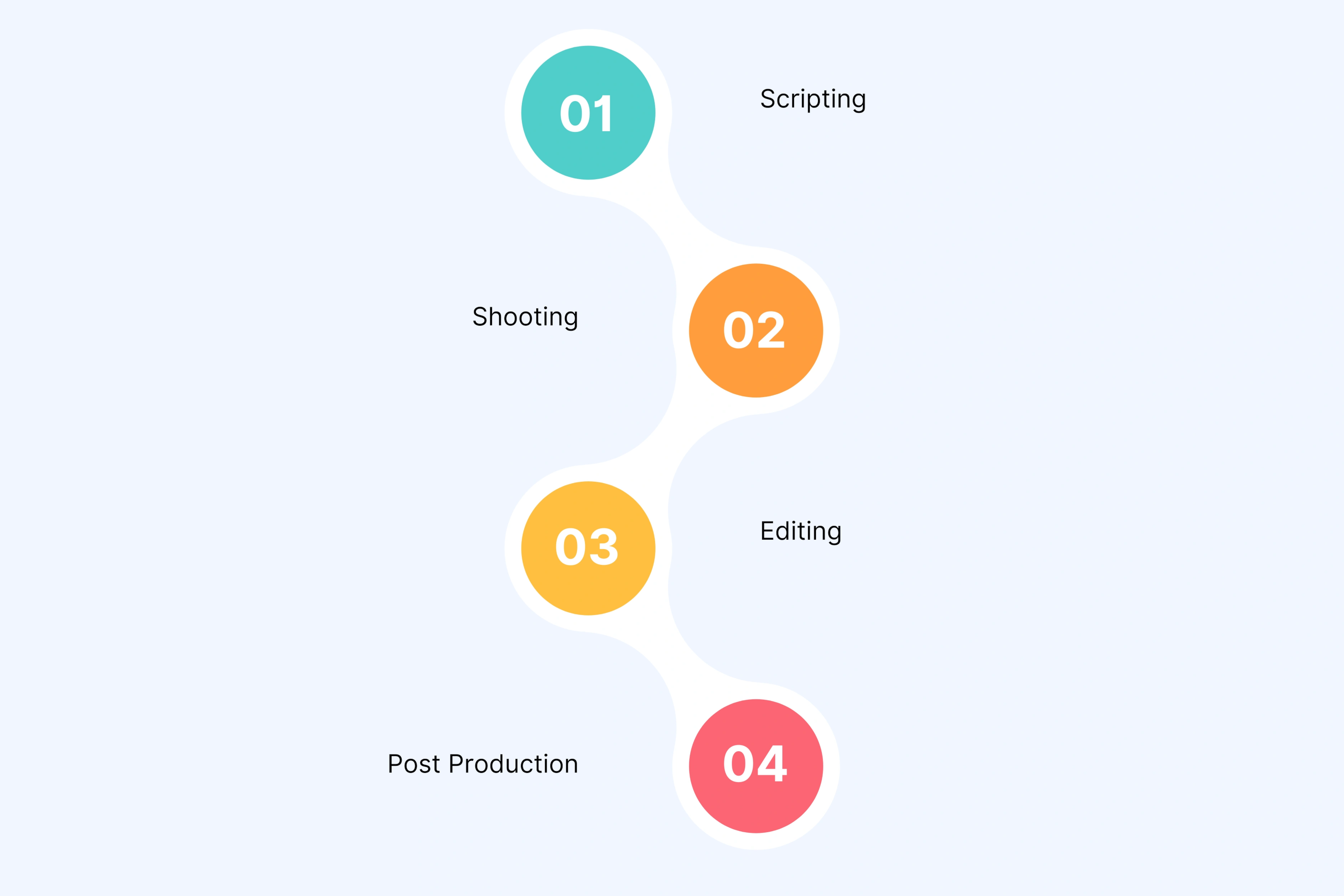
Here is what happens at every stage:
Scripting - Writing fresh concepts for 30 videos takes weeks, not days
Shooting - Scheduling talent, locations, and equipment for multiple products creates coordination nightmares
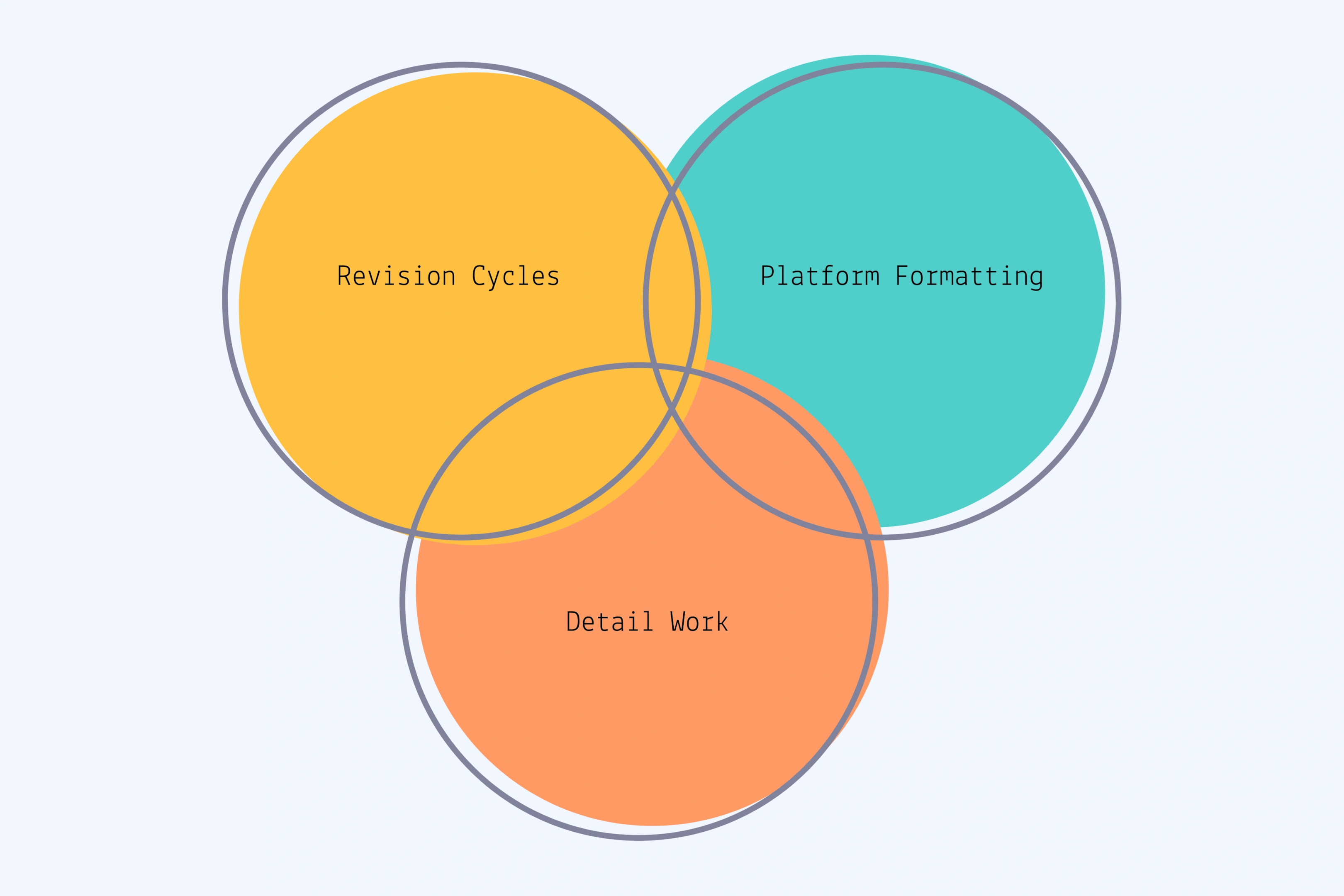
Editing - Each video needs individual attention, review cycles, and revisions
Post production - Adding graphics, music, captions, and platform-specific formats multiplies the timeline
Hiring more people does not fix this. More team members mean more project management overhead and inconsistent quality across videos.
Take a D2C brand that needs 30 product demos. The traditional approach requires 30 separate shoots, scripts, and editing cycles. That costs $50,000 and takes 3 to 4 months.
What "Scalable Video Production" Actually Means (Beyond Just Making More Videos)
Scalable video production means you can increase output without increasing costs at the same rate. Video’s impact on growth is well‑documented: multiple studies now project that video will account for more than 80% of all internet traffic, and brands consistently report strong ROI from sustained video investment rather than one‑off campaigns. Your 50th video should not cost as much as your first video.
Most teams confuse making more videos with having scalable production capabilities. Making more videos the old way just means working harder. Scalable production means working smarter with systems that improve over time.
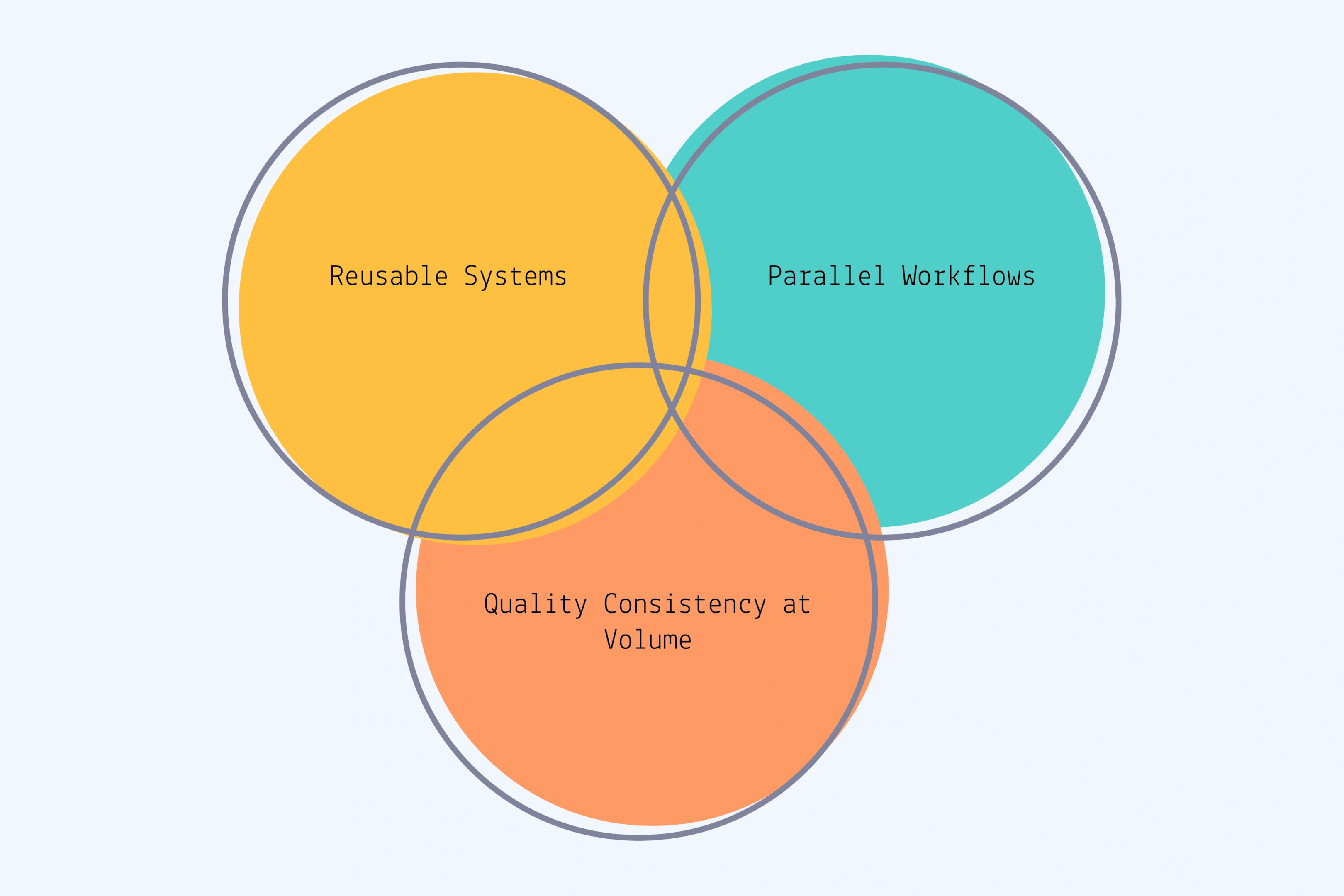
True scalability has three pillars:
Reusable systems - Templates, brand assets, and trained resources you build once and use forever
Parallel workflows - Multiple videos move through production at the same time, not one after another
Quality consistency at volume - Speed matters, but only if quality stays high
The Economics of Scale in Video Content Creation
Here is how costs change with scale. Your first video might cost $2,000. Your 10th video costs $700. Your 100th video costs $200.
This happens because fixed costs get spread across more videos. Building templates, creating brand guidelines, and training assets are one-time investments. Variable costs like editing drop as your team gets faster and processes get cleaner.
Medium-touch videos - Product demos and explainers work at 10 to 20 per month with standardized formats
High-volume content - Social posts, testimonials, and user generated content style videos scale to 30 to 100 per month with templates
Match your production approach to the content type. Do not use a cinematic workflow for social media content that needs speed. Build a realistic content calendar based on what your team can actually deliver.
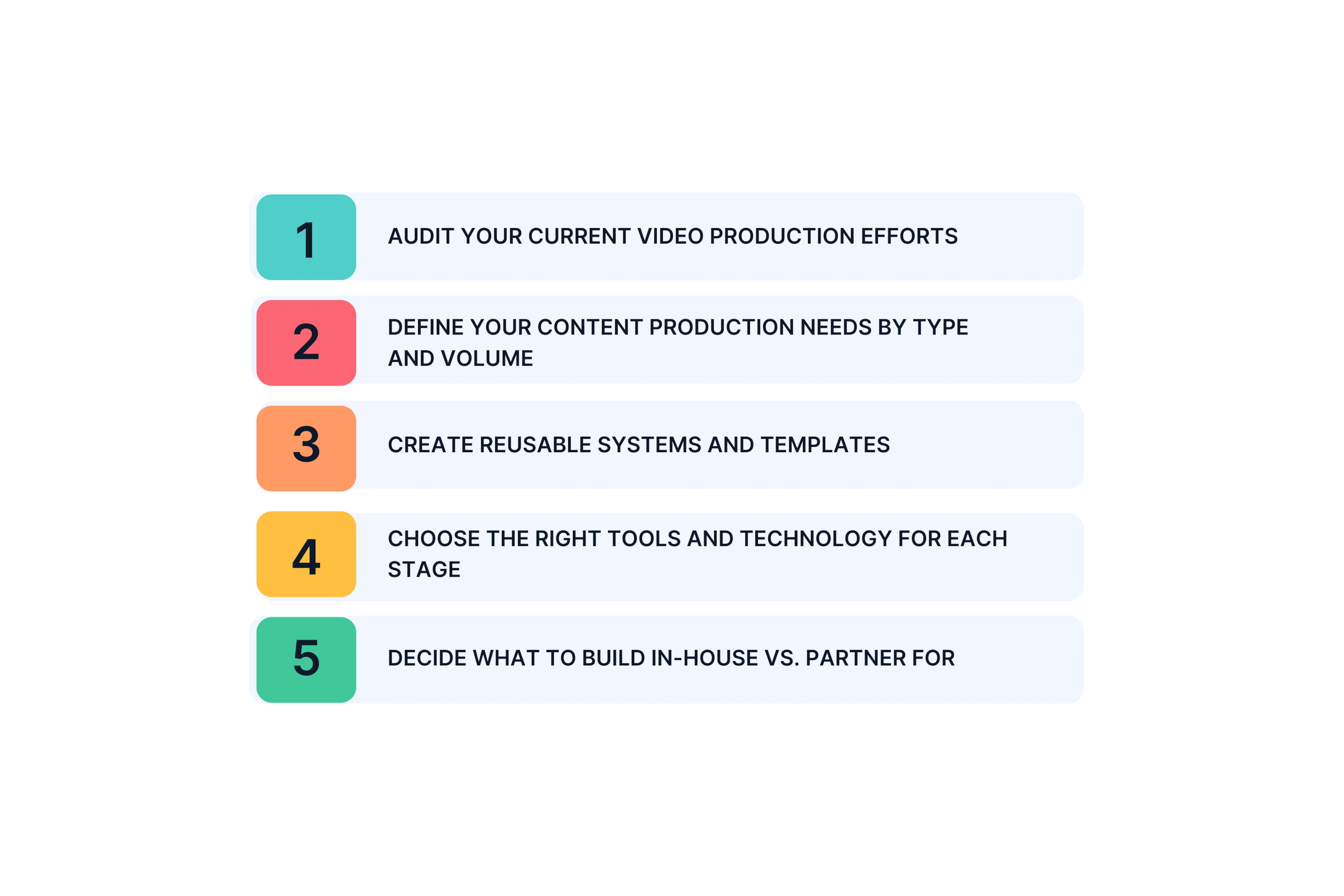
Step 3 - Create Reusable Systems and Templates
Reusable assets are what make scale possible. Build them once and use them forever.
Brand consistency frameworks - Create visual templates, brand guidelines, and tone of voice documents that keep every video on brand
Modular content libraries - Stock your asset library with product footage, b-roll, graphics, and music tracks
Standardized elements - Design intro and outro templates, lower thirds, and transitions that work across all videos
Document every workflow so the knowledge stays with your team, not in one person's head. A solid foundation of reusable assets lets you produce 10 video variations in the time one video used to take.
Building this infrastructure in-house takes 6 to 12 months. Months 1 to 3 go to hiring and setup. Months 4 to 6 cover training and template creation. Months 7 to 9 bring your first real volume attempts with plenty of failures. Months 10 to 12 are for fine tuning. Hidden costs run $150,000 to $300,000 before you produce efficiently at scale.
Step 4 - Choose the Right Tools and Technology for Each Stage
Buy tools to solve specific bottlenecks. Do not buy tools hoping they fix everything.
Project management - Tools like Asana or Monday keep your team coordinated
Asset libraries - Digital asset management systems organize your content
Editing automation - Workflow tools speed up post production tasks
Distribution - Scheduling platforms manage your content calendar
Balance efficiency with professional control. The right tools are your best friend when solving specific problems. But tools do not replace strategy or the human touch in quality checks.
Step 5 - Decide What to Build In-House vs. Partner For
Be honest about what your team can handle. Building video production capabilities in-house costs more than most teams expect.
Build in-house for - Strategic planning, brand oversight, and final distribution decisions
Partner for - Volume execution, specialized production types, and scalable video workflows
Creative partners bring capabilities that take a year to build internally. They have custom AI avatar video services, trained product assets, and personalized video production at scale ready to use now. When you need 20 to 100 videos monthly, partnering makes more sense than building.
The Hidden Reality of Building Scalable Production In-House
Building scalable video production internally costs more and takes longer than most teams expect. Here is what the actual timeline looks like.
The 6-12 Month Ramp-Up Nobody Talks About
Phase 1: Setup (Months 1-3)
You start by hiring video producers at $70,000 to $90,000, editors at $50,000 to $70,000, and project managers at $60,000 to $80,000. Equipment and software run another $30,000 to $50,000.
Your output during this phase stays at 5 to 10 videos per month. Barely more than before.
Phase 2: Optimization (Months 4-9)
Your team learns brand consistency through trial and error. You build template libraries and figure out what works for your business and audience. Coordination gets harder as complexity grows.
Output climbs to 15 to 25 videos per month. Still not at scale.
Phase 3: True Scale (Months 10-12+)
Systems finally work smoothly. Production timelines become predictable. Quality stays consistent across volume. If everything went right, you hit 40 to 60 videos per month.
Why Most In-House Scale Attempts Stall at 20-25 Videos/Month
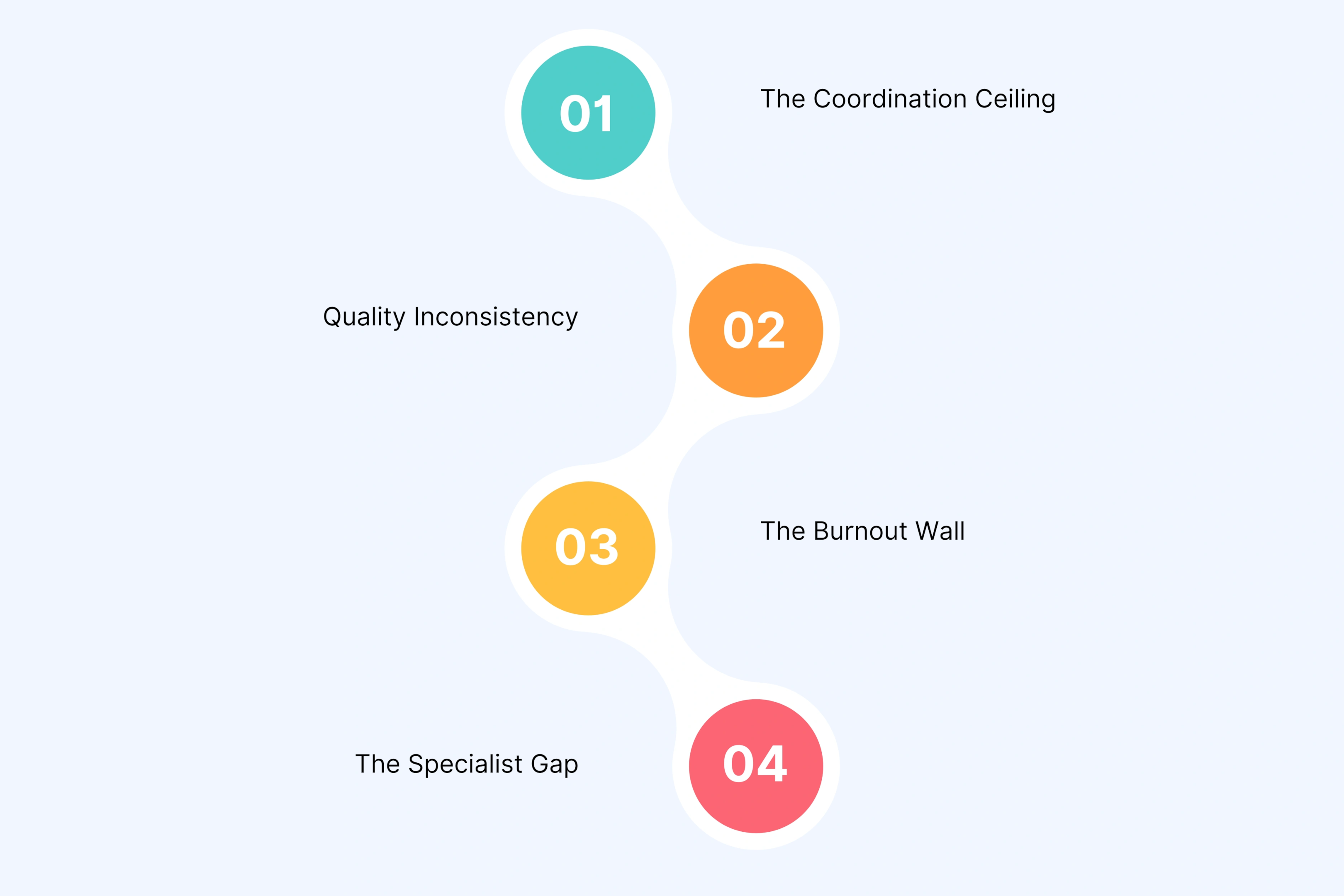
Most teams hit a wall before reaching their goal. Here are the common failure points.
The coordination ceiling - Managing 5 video projects at once needs different skills than managing 1
Quality inconsistency - Different editors create different styles, which breaks brand consistency
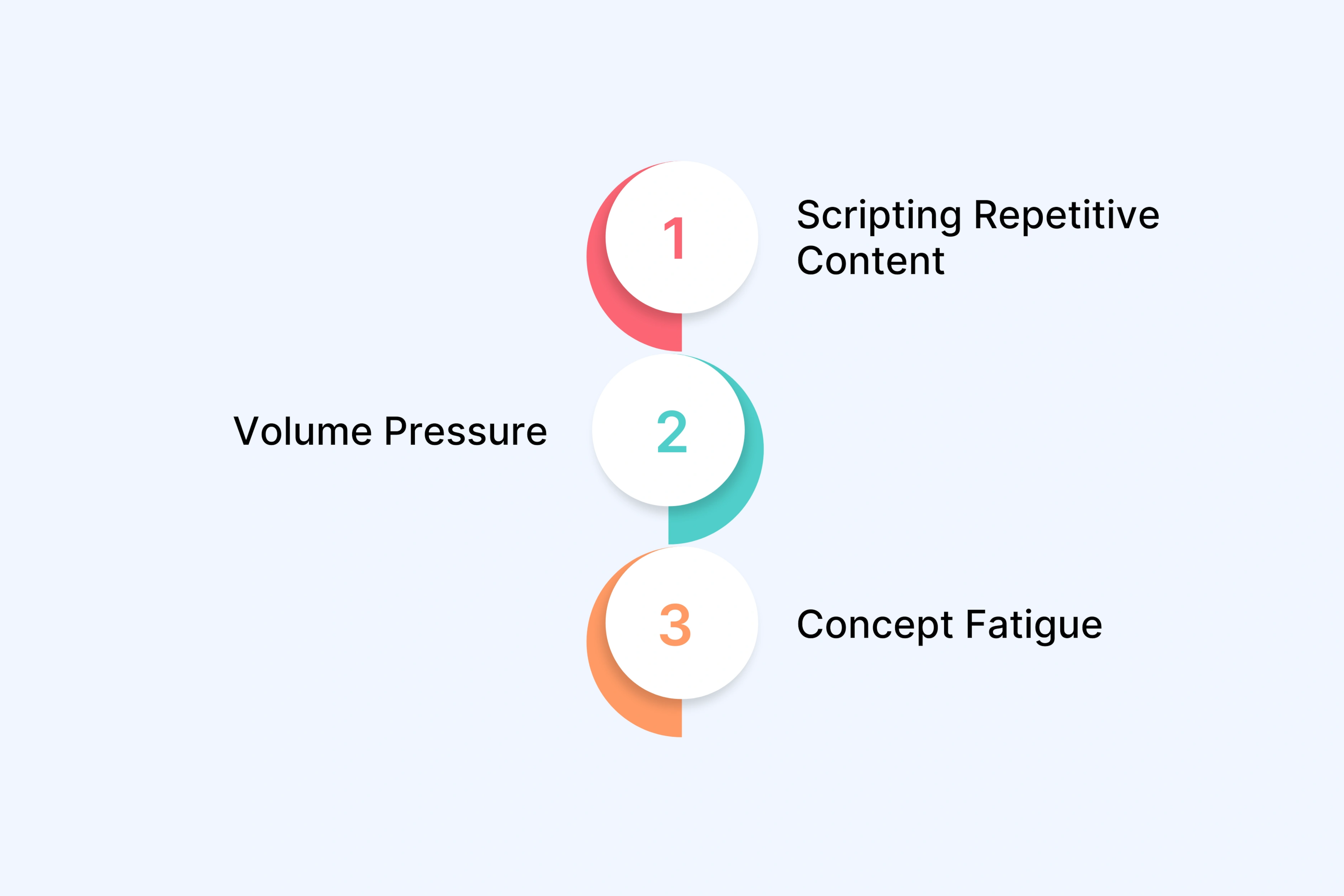
The burnout wall - Repetitive tasks at scale drain even strong creative teams
The specialist gap - Video marketing needs motion graphics, color grading, and sound design. Hiring separately for each specialty is crucial but expensive.
Building scalable production in-house is possible. But most teams underestimate the investment by 3 to 5 times and the timeline by 2 to 3 times. That gap between expectation and reality kills most attempts before they reach maximum impact.
How to Maintain Quality While Scaling Video Production
The biggest fear about scaling is simple. Will more videos mean worse quality? Not if you build the right systems.
Quality Doesn't Mean Perfection for Every Video
Different videos serve different purposes. A brand campaign video needs high production value. A user generated content style video for social proof needs authenticity more than polish.
The crowded market demands both volume and quality. You need enough videos to stay visible and enough quality to convert viewers into customers.
Systems That Protect Quality at Scale
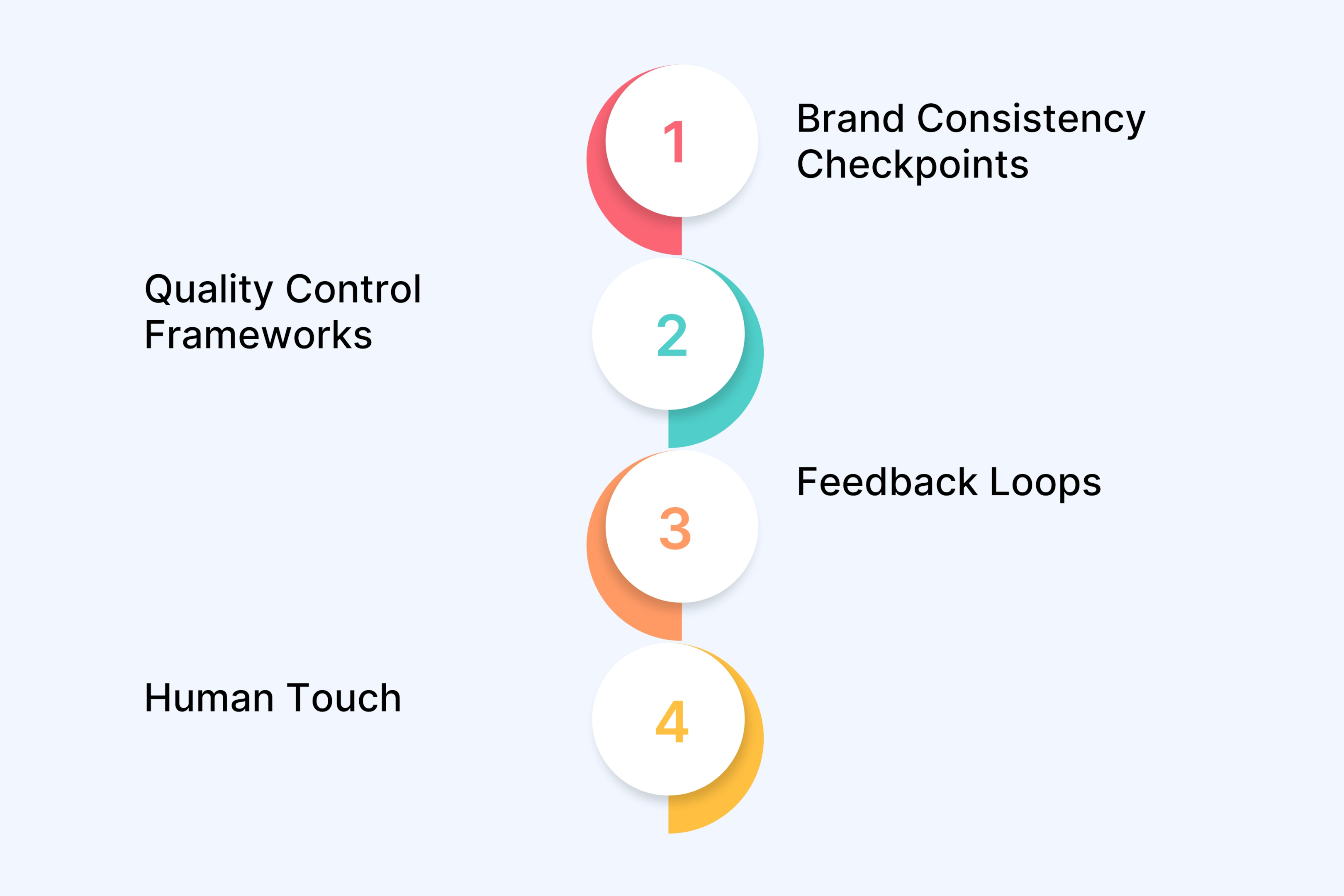
Quality at scale comes from systems, not individual heroic effort.
Brand consistency checkpoints - Review videos at key stages before they move forward
Quality control frameworks - Define what to check, when to check it, and who checks it
Feedback loops - Use what you learn from each batch to fine tune your process
Human touch - Keep real people in the approval stages, even when you automate production
Build guardrails that protect quality without slowing everything down. Gates that require 10 approvals will kill your timeline. Smart checkpoints at crucial stages keep quality high without creating bottlenecks.
The Cost Reality of Scaling Video Production
Traditional video production costs $2,000 to $10,000 per video. That money goes to pre-production planning, shoot days, post production editing, and revision rounds.
Where Budget Actually Scales (and Where It Doesn't)
Some costs stay fixed no matter how many videos you make. Strategy, planning, and brand development do not change with volume.
Variable costs drop as you scale. Shooting, talent coordination, editing time, and repetitive tasks get cheaper per video.
Smart investments pay compounding returns. Trained resources, template libraries, and partner relationships cost money upfront but save money forever.
Here is a practical example. Your first month costs $15,000 for 10 videos at $1,500 each. By month six, you produce 30 videos for $20,000 total. That is $667 per video, not $45,000.
Real Cost Comparison Across Production Models
Production Model
Cost Per Video
Timeline Per Video
Realistic Monthly Volume
Total Monthly Cost (50 videos)
Traditional Agency
$3,000–$8,000
2–4 weeks
5–10 videos max
Not feasible at 50/mo
In-House Team
$800–$2,000
1–2 weeks
20–30 videos max
$40K–$100K (after 12mo ramp)
Creative Partner
$400–$1,200
24–72 hours
50–100+ videos
$20K–$60K
Note: In-house costs include fully-loaded salaries, tools, and overhead divided by output.
Choosing Between In-House Teams, Agencies, and Creative Partners
You have three options for scaling video production. Each works for different situations and budgets.
The In-House Approach
Building an internal team gives you total control over your brand and creative direction. Your team understands your company culture deeply.
The reality:
Significant upfront investment in talent, equipment, and tools
6 to 12 month ramp-up before reaching true scale
Capacity ceiling based on team size
Hard to scale beyond 20 to 30 videos per month without major hiring
Burnout risk when demand spikes
Best for: Companies with $300,000+ annual video budgets and commitment to a 12 month build timeline.
The Traditional Agency Model
Agencies deliver professional quality and bring fresh creative ideas. You get access to specialized skills without building internal infrastructure.
The problems:
Expensive at volume with per-project pricing
Slower turnaround because you wait in their queue
Not designed for producing content at scale
Relationship resets with each project
Maximum output around 5 to 10 videos per month
Best for: High-stakes, low-volume projects like TV commercials and brand films.
The Creative Partner Approach
Creative partners are built specifically for scalable video production. They combine strategy and execution end-to-end.
What you get:
Production timelines in days or hours, not weeks
Cost effective pricing models that reward volume
Dedicated partnership that learns your brand over time
Access to brand safe AI avatars and personalized video production at scale
Scalable from 20 to 200+ videos per month
No 6 to 12 month ramp-up period
The trade-offs:
Less control over day-to-day production decisions
Initial onboarding takes 1 to 2 weeks for brand alignment
Best for: Teams needing 20 to 100+ videos per month without building massive internal capabilities.
Creative partners focus on solving the scale problem, not just making one video at a time.
What Modern Creative Partners Can Do That Wasn't Possible 2 Years Ago
Creative partners design custom virtual characters tailored to your exact target audience. You specify ethnicity, gender, age, and style. The result looks authentic enough to pass as real user generated content while maintaining the human touch.
Why it matters for scale:
Create once, reuse infinitely across campaigns
No talent scheduling, contracts, or coordination overhead
Consistent brand representation across 50+ videos
Cost drops dramatically after initial character design
Use these virtual influencers for product demos, testimonials, social media content, and educational videos. Building this capability in-house would require AI specialists, 3D artists, and 6+ months of experimentation. Creative partners have this production-ready now.
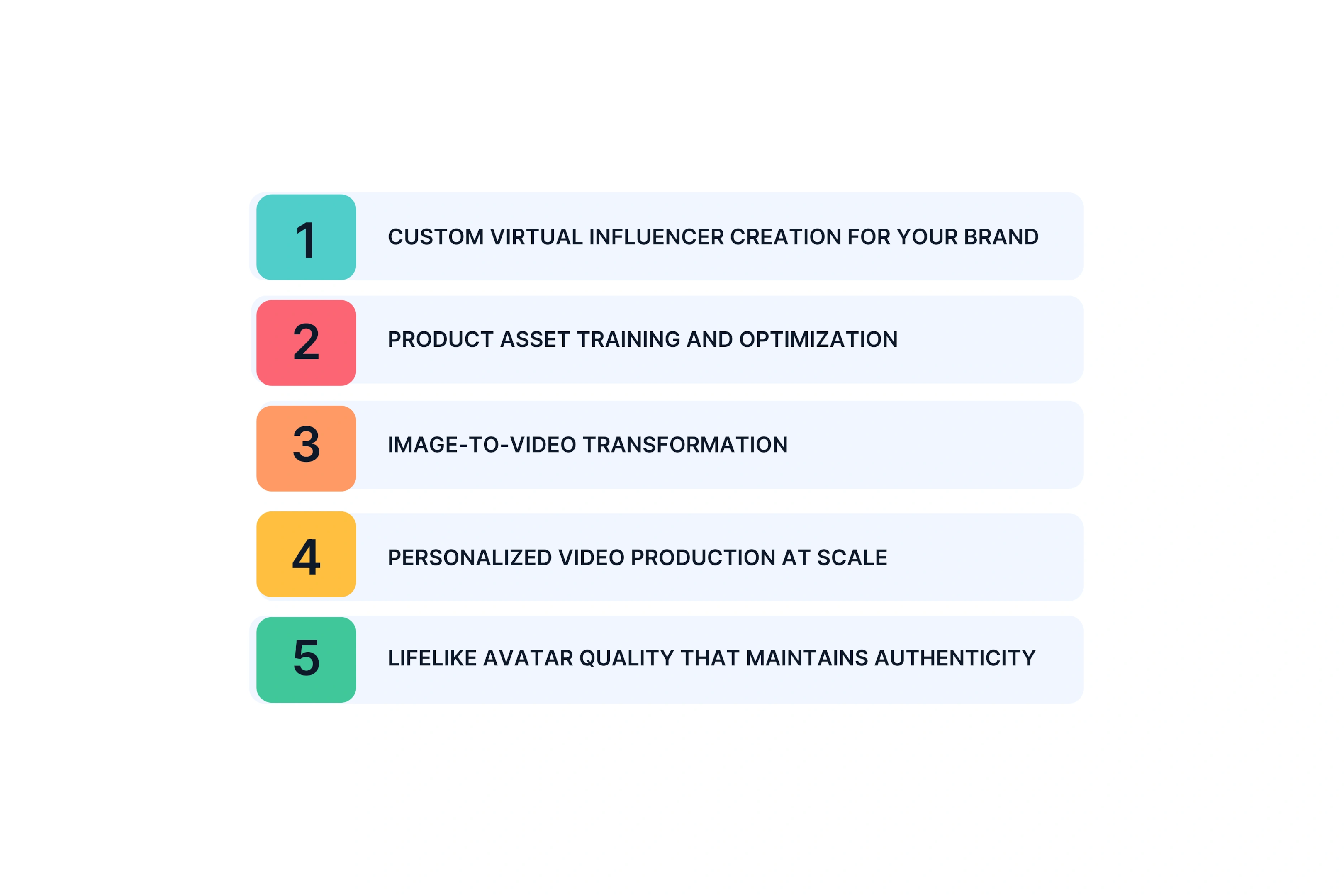
Product Asset Training and Optimization
Partners train AI models on your specific products for optimal representation across any scenario. You upload product images and specifications once. The partner trains the AI. Your product can then be rendered in any lighting, context, or scene with precision quality.
Why it matters for scale:
One product shoot becomes 50+ video variations
No need to re-shoot product b-roll for every video
Consistent product representation across all content
Update product details once, applies to all future videos
An e-commerce brand with 50 SKUs traditionally needs 50 separate product shoots. With trained product assets, one optimization session per product enables unlimited video variations.
Convert any static product image into dynamic video b-roll with motion. Timeline runs 24 to 48 hours. Input your product image plus motion specifications like zoom, pan, rotate, or 3D effects. Output is professional product b-roll ready for any video.
Why it matters for scale:
No video shoots needed for every product angle
Transform your existing product photography library into video assets
Create multiple variations without reshooting
Fast turnaround for seasonal or time-sensitive content
Personalized Video Production at Scale
Mass customization lets you embed dynamic variables in videos. Add personalized greetings with names and company names. Include location-specific content for city, region, or store. Customize offers, pricing, and role-specific messaging.
Scale potential: Produce 1 master video, generate 10,000 personalized variations.
Use this for personalized email campaigns, WhatsApp video outreach, account-based marketing, and customer onboarding sequences. Creating 1,000 personalized videos manually would take months and cost $50,000+.
Lifelike Avatar Quality That Maintains Authenticity
Modern AI spokesperson video services produce photorealistic avatars with natural movements, expressions, and lip-sync. Multiple avatar options span demographics. Quality is indistinguishable from real footage in social media contexts.
The technology crossed a threshold in 2024 where brand safe AI avatars work for real marketing campaigns, not just demos. This enables scalable video production that was impossible 2 years ago.
These capabilities require significant technology investment and expertise. Most companies cannot justify building them internally, but they are production-ready with specialized creative partners.
How a Creative Partner Approach Enables True Scale
A creative partner combines strategic collaboration with execution. This is not a vendor relationship where you place orders and wait for delivery.
Partners maintain quality while increasing speed through deep brand immersion. They learn your tone, audience, and goals. They build reusable trained assets specific to your brand. Parallel production workflows let them work on multiple videos simultaneously. Iterative improvement means they get better over time based on what works.
The Strategic Difference: Partners Think, Vendors Execute
Traditional vendor relationship: You say "make this video." They say "okay, that is $5,000 and 3 weeks." Repeat for every single video.
Creative partner relationship: You say "we need to scale product demos across 30 SKUs." They respond "let's create a reusable system. We will design a virtual influencer matching your ICP, train your product assets, establish a template structure, and produce the first 10 to validate. Then we can scale to 30 in the same timeframe."
The outcome is a strategic solution, not transactional execution.
What to Look For in a Scalable Production Partner
Must-have capabilities:
Video production across multiple formats and styles
Portfolio showing volume and consistency, not just highlight reels
Clear processes for brand consistency and approvals
Transparent pricing that rewards scale
Strategic guidance, not just order-taking
Technology infrastructure for rapid turnaround
Proven track record at 50+ videos per month for clients
Red flags:
"We can make anything" without specialized scalability focus
Per-video pricing with no volume discounts
No examples of high-volume client relationships
Turnaround times similar to traditional agencies at 2 to 4 weeks
Real-World Example: Scaling From 10 to 100+ Videos Per Month
Here is how one e-commerce brand scaled video production without breaking their budget or timeline.
The Challenge: E-Commerce Brand Needs Volume Across 40+ Product Lines
A D2C e-commerce brand with 40 product SKUs was producing 8 to 10 product demo videos per month through a traditional agency. Cost ran $4,000 per video or $32,000 to $40,000 monthly. Timeline was 2 to 3 weeks per video batch.
They needed 80+ videos across their product catalog plus seasonal variations and social content.
The traditional math did not work. 80 videos at $4,000 each equals $320,000. Timeline would stretch 10 to 12 months working sequentially. Not financially viable and the market opportunity would pass.
The Unscript Approach: Building Scalable Systems
Month 1: Foundation - Unscript started with deep brand immersion to understand tone, visual style, and target audience. They created a custom virtual influencer matching the brand's primary ICP (female, 25 to 34, lifestyle-focused). They trained AI models on 5 hero products for testing and established brand consistency guidelines and approval workflows.
Output: 10 test videos to validate the approach.
Month 2: Scale - Unscript trained the remaining 35 product assets for optimal rendering. They established reusable template structures across 3 video styles. Parallel production workflows handled 20+ videos simultaneously. An A/B testing framework let the brand try different messaging approaches.
Output: 40 product demo videos across the primary catalog.
Month 3: Optimization - Unscript fine tuned based on client feedback. They created seasonal variations using existing product assets. Social media content production added short-form variations. Personalized video campaigns went live for email marketing.
Output: 60+ videos including demos, social content, and personalized variations.
The Results: 5x Volume, 80% Cost Reduction
Metric
Traditional Agency
Unscript Partnership
Total videos produced
15–20 in 3 months
110+ in 3 months
Cost per video
$4,000
$600–$800
Total investment
$60K–$80K
$70K for 3 months
Timeline per video
2–3 weeks
24–48 hours
Scalability ceiling
~10 videos/month max
100+ videos/month
Brand consistency
Variable (different crews)
Highly consistent
Reusability
Limited
High (trained assets)
The Results: 5x Volume, 80% Cost Reduction
The brand launched full product catalog coverage in one quarter instead of one year. A/B testing became possible across multiple video variations per product. They could respond to market trends with new videos in 48 hours instead of weeks. Budget flexibility shifted from production costs to paid distribution.
The critical factor: This was not achievable with a tool or traditional agency. It required a creative partner with specialized scalability infrastructure, strategic thinking, and production capabilities built specifically for volume.
Practical Tips for Scaling Video Production Effectively (Quick Wins)
Here are actionable tactics you can implement immediately:
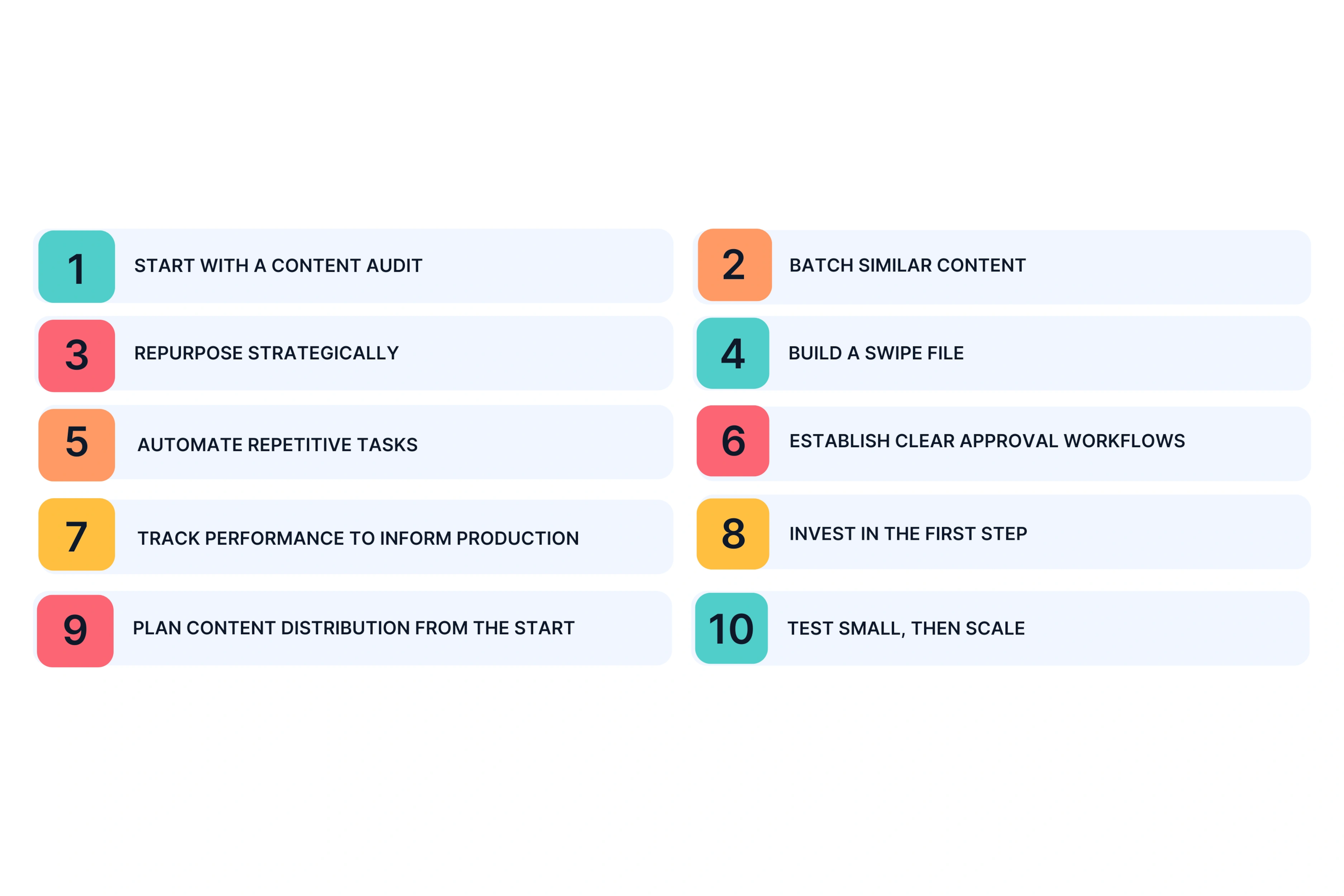
Start with a content audit - Know what you're producing before optimizing
Batch similar content - Shoot 5 product demos in one session, not five separate shoots
Repurpose strategically - One video becomes 10 variations for different platforms
Build a swipe file - Save successful concepts, templates, styles for future use
Establish clear approval workflows - Bottlenecks often hide in revision cycles
Track performance to inform production - Make more of what works (creating engaging content efficiently)
Invest in the first step - Better briefs = faster production
Plan content distribution from the start - Don't just make videos, plan where they go
Test small, then scale - Prove the system works with 10 videos before committing to 100
Focus on speed for social media platforms content (fresher = more engaging). Prioritize brand consistency over viral trends that don't fit. Remember the human touch in approval stages, even when automating production. Don't aim for perfection on every video. The crowded market rewards consistency + quality, not perfection.
Common Mistakes That Break Video Production at Scale
Learn from what does not work:
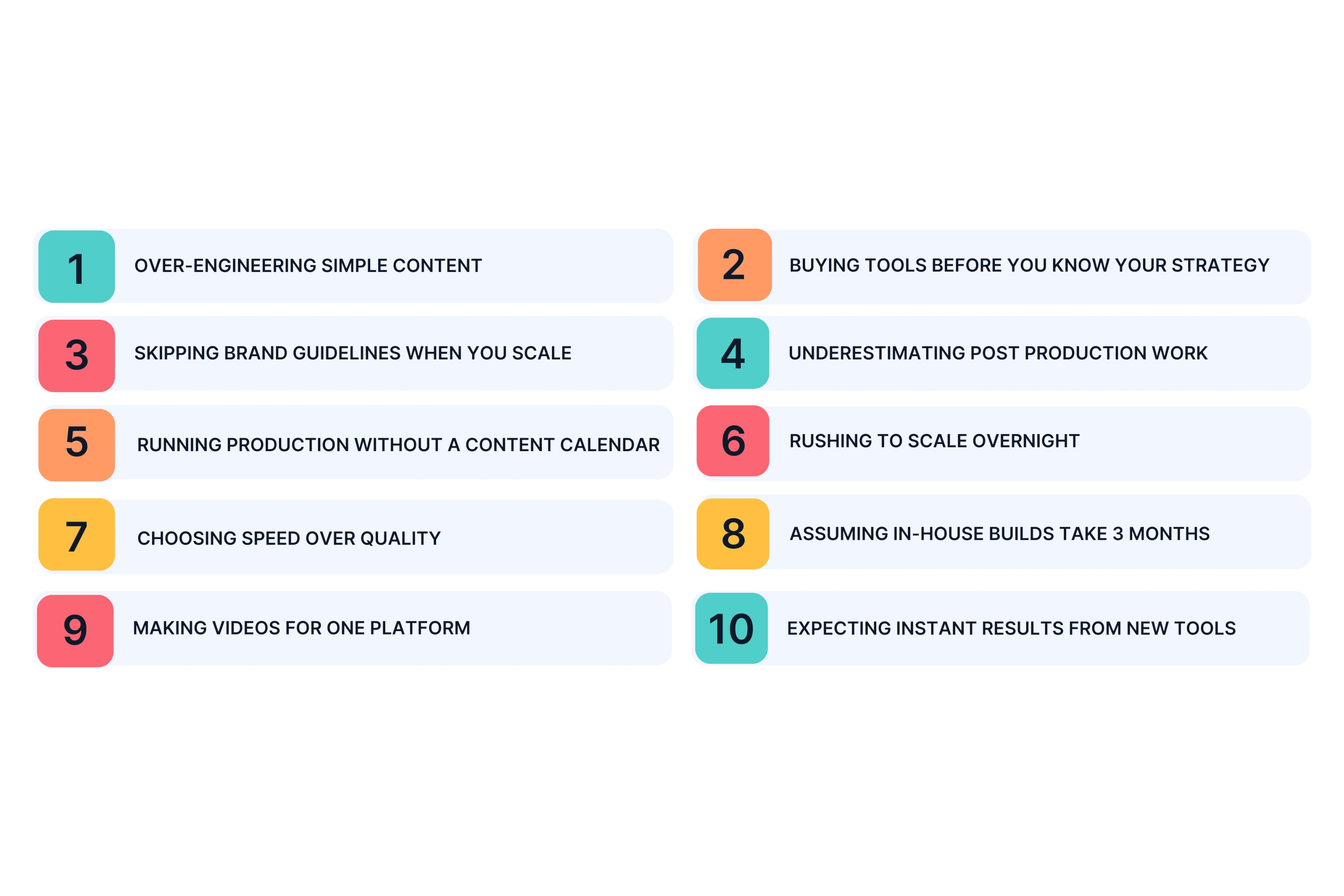
Mistake 1: Over-engineering simple content. A social media post does not need the same production as a brand film.
Mistake 2: Buying tools before you know your strategy. Technology cannot fix unclear goals.
Mistake 3: Skipping brand guidelines when you scale. Your output becomes inconsistent fast.
Mistake 4: Underestimating post production work. Editing, revisions, and formatting take longer than most teams expect.
Mistake 5: Running production without a content calendar. Poor planning creates chaos at volume.
Mistake 6: Rushing to scale overnight. Building systems takes time. Scale is not a pipe dream you implement in a week.
Mistake 7: Choosing speed over quality. Bad videos hurt your brand in a crowded market.
Mistake 8: Assuming in-house builds take 3 months when they actually take 12 months.
Mistake 9: Making videos for one platform, then adapting later. Plan for multiple channels from day one.
Mistake 10: Expecting instant results from new tools. Essential processes need time to work.
Scalable video production is a marathon. No single purchase or decision gets you there.
What This Means for Teams Ready to Scale Video Content
Scaling video production is not about working harder or spending more. It is about building systems and making strategic choices.
Building in-house takes 6 to 12 months and $250,000 to $500,000. Traditional agencies max out at 10 to 15 videos monthly. Creative partners built for scale deliver 20 to 100+ videos per month with turnaround in days or hours.
Most marketing teams cannot cost effectively produce 50+ quality videos monthly alone. The ones that scale successfully have found partners designed specifically for volume production.
Unscript works with D2C brands and e-commerce teams needing consistent video content without sacrificing quality or brand consistency. From product demos to personalized campaigns, we handle end-to-end production.
Scalable video production means you can increase video output without proportionally increasing costs, time, or team size. Your 100th video costs a fraction of your first video while maintaining brand consistency and quality.
How much does it cost to scale video production?
Traditional methods cost $2,000 to $10,000+ per video. Building in-house requires $250,000 to $500,000 over 6 to 12 months. Creative partners designed for scale offer volume pricing at $400 to $1,200 per video once systems are established.
Can you maintain quality when producing more videos?
Yes. Quality at scale comes from clear brand guidelines, reusable templates, trained assets, and quality checkpoints throughout production. Not every video needs cinematic quality. Match production standards to content purpose.
What's the difference between a creative partner and a video production agency?
Traditional agencies work project-by-project with 2 to 4 week timelines. Creative partners focus on scalable video production with 24 to 72 hour turnaround and pricing designed for volume. Partners build reusable systems and offer specialized capabilities like virtual influencer creation and personalized video at scale.
How long does it take to scale video production?
Building in-house takes 6 to 12 months. With a creative partner, expect 1 to 2 weeks for onboarding and brand alignment, then immediate access to scalable production. Most brands scale from 10 to 15 videos monthly to 50 to 100+ within the first quarter.
Should I build an in-house video team or partner with a creative partner?
Build in-house if you have $250,000 to $500,000 budget, 6 to 12 months timeline, and need complete control. Partner if you need 20 to 100+ videos monthly without massive hiring, want speed without sacrificing quality, or need specialized capabilities like brand safe AI avatars.
How do you create brand consistency across many videos?
Establish clear brand guidelines upfront. Create reusable asset libraries with logos, graphics, music, and trained product assets. Implement approval workflows at key stages. Document processes so quality does not depend on individual memory.
What types of video content are easiest to scale?
Product demos, customer testimonials, user generated content style videos, social media content, educational videos, and personalized video campaigns scale easiest. These benefit from reusable templates and trained assets.
What are virtual influencers and how do they help scale video production?
Virtual influencers are custom AI-generated characters tailored to your brand's target audience. Once created, they can be reused infinitely across campaigns without talent scheduling or coordination costs. They maintain lifelike quality while enabling consistent brand representation across 50+ videos.
How fast can videos be produced at scale?
Traditional agencies take 2 to 4 weeks per video. In-house teams need 1 to 2 weeks. Creative partners built for scale deliver in 24 to 72 hours for standard formats. Same-day turnaround is possible for high-volume social content using existing trained assets.
Can I A/B test video content at scale?
Yes. With scalable systems and creative partners, you can produce multiple video variations for the same base cost. Brands often produce 3 to 5 variations per concept to test what works before scaling the winning approach across platforms.
Let's Turn Your Scripts into Stunning Videos. Sign Up Now.
Stop struggling with video creation. Our AI simplifies the process, letting you create professional-looking videos from text in record time. Try it for free today!
How to Build Scalable Video Production That Actually Works Long-Term
Learn how to scale video production without sacrificing quality or budget. Practical strategies for creating consistent streams of content across platforms.
Your marketing calendar demands 30 or 50 videos every month. But your current setup takes two weeks per video. The math does not work.
Most teams hit the same wall. They hire more people, spend more money, or lower their quality standards. None of these options solve the real problem.
Scalable video production means you can make more videos without spending more time or money for each one. This guide shows you where traditional video production breaks down and how to build a system that grows with your needs.
No hype. Just practical steps.
Key Takeaways
Traditional Production Fails: Most video production costs $2,000 to $10,000 per video and takes 2 to 4 weeks, which does not scale because every video needs the same work from scratch. Recent production benchmarks show that live‑action marketing videos commonly range from around $2,000 on the low end to $50,000 or more for higher‑end campaigns, depending on complexity and length.
Building In-House Takes Time: Plan for 6 to 12 months and budget $250,000 to $500,000 before you reach true scale
Scale Needs Systems: Reusable templates, trained assets, and parallel workflows cut costs per video while maintaining brand consistency
Creative Partners Enable Volume: Built specifically to solve the scale problem with finished videos delivered in 24 to 72 hours
Quality Stays Consistent: Systems and clear guidelines protect quality better than individual effort across high volumes
Partner vs Build Decision: Build in-house if you have 12 months and $300,000+ budget, or partner when you need 20 to 100+ videos monthly
Why Traditional Video Production Can't Scale (The Bottleneck Problem)
Traditional video production follows a simple rule. More videos equal more time, more money, and more people. This linear cost model works fine when you need one or two videos. It breaks when you need 30 or 50.
Here is what happens at every stage:
Scripting - Writing fresh concepts for 30 videos takes weeks, not days
Shooting - Scheduling talent, locations, and equipment for multiple products creates coordination nightmares
Editing - Each video needs individual attention, review cycles, and revisions
Post production - Adding graphics, music, captions, and platform-specific formats multiplies the timeline
Hiring more people does not fix this. More team members mean more project management overhead and inconsistent quality across videos.
Take a D2C brand that needs 30 product demos. The traditional approach requires 30 separate shoots, scripts, and editing cycles. That costs $50,000 and takes 3 to 4 months.
What "Scalable Video Production" Actually Means (Beyond Just Making More Videos)
Scalable video production means you can increase output without increasing costs at the same rate. Video’s impact on growth is well‑documented: multiple studies now project that video will account for more than 80% of all internet traffic, and brands consistently report strong ROI from sustained video investment rather than one‑off campaigns. Your 50th video should not cost as much as your first video.
Most teams confuse making more videos with having scalable production capabilities. Making more videos the old way just means working harder. Scalable production means working smarter with systems that improve over time.
True scalability has three pillars:
Reusable systems - Templates, brand assets, and trained resources you build once and use forever
Parallel workflows - Multiple videos move through production at the same time, not one after another
Quality consistency at volume - Speed matters, but only if quality stays high
The Economics of Scale in Video Content Creation
Here is how costs change with scale. Your first video might cost $2,000. Your 10th video costs $700. Your 100th video costs $200.
This happens because fixed costs get spread across more videos. Building templates, creating brand guidelines, and training assets are one-time investments. Variable costs like editing drop as your team gets faster and processes get cleaner.
Medium-touch videos - Product demos and explainers work at 10 to 20 per month with standardized formats
High-volume content - Social posts, testimonials, and user generated content style videos scale to 30 to 100 per month with templates
Match your production approach to the content type. Do not use a cinematic workflow for social media content that needs speed. Build a realistic content calendar based on what your team can actually deliver.
Step 3 - Create Reusable Systems and Templates
Reusable assets are what make scale possible. Build them once and use them forever.
Brand consistency frameworks - Create visual templates, brand guidelines, and tone of voice documents that keep every video on brand
Modular content libraries - Stock your asset library with product footage, b-roll, graphics, and music tracks
Standardized elements - Design intro and outro templates, lower thirds, and transitions that work across all videos
Document every workflow so the knowledge stays with your team, not in one person's head. A solid foundation of reusable assets lets you produce 10 video variations in the time one video used to take.
Building this infrastructure in-house takes 6 to 12 months. Months 1 to 3 go to hiring and setup. Months 4 to 6 cover training and template creation. Months 7 to 9 bring your first real volume attempts with plenty of failures. Months 10 to 12 are for fine tuning. Hidden costs run $150,000 to $300,000 before you produce efficiently at scale.
Step 4 - Choose the Right Tools and Technology for Each Stage
Buy tools to solve specific bottlenecks. Do not buy tools hoping they fix everything.
Project management - Tools like Asana or Monday keep your team coordinated
Asset libraries - Digital asset management systems organize your content
Editing automation - Workflow tools speed up post production tasks
Distribution - Scheduling platforms manage your content calendar
Balance efficiency with professional control. The right tools are your best friend when solving specific problems. But tools do not replace strategy or the human touch in quality checks.
Step 5 - Decide What to Build In-House vs. Partner For
Be honest about what your team can handle. Building video production capabilities in-house costs more than most teams expect.
Build in-house for - Strategic planning, brand oversight, and final distribution decisions
Partner for - Volume execution, specialized production types, and scalable video workflows
Creative partners bring capabilities that take a year to build internally. They have custom AI avatar video services, trained product assets, and personalized video production at scale ready to use now. When you need 20 to 100 videos monthly, partnering makes more sense than building.
The Hidden Reality of Building Scalable Production In-House
Building scalable video production internally costs more and takes longer than most teams expect. Here is what the actual timeline looks like.
The 6-12 Month Ramp-Up Nobody Talks About
Phase 1: Setup (Months 1-3)
You start by hiring video producers at $70,000 to $90,000, editors at $50,000 to $70,000, and project managers at $60,000 to $80,000. Equipment and software run another $30,000 to $50,000.
Your output during this phase stays at 5 to 10 videos per month. Barely more than before.
Phase 2: Optimization (Months 4-9)
Your team learns brand consistency through trial and error. You build template libraries and figure out what works for your business and audience. Coordination gets harder as complexity grows.
Output climbs to 15 to 25 videos per month. Still not at scale.
Phase 3: True Scale (Months 10-12+)
Systems finally work smoothly. Production timelines become predictable. Quality stays consistent across volume. If everything went right, you hit 40 to 60 videos per month.
Why Most In-House Scale Attempts Stall at 20-25 Videos/Month
Most teams hit a wall before reaching their goal. Here are the common failure points.
The coordination ceiling - Managing 5 video projects at once needs different skills than managing 1
Quality inconsistency - Different editors create different styles, which breaks brand consistency
The burnout wall - Repetitive tasks at scale drain even strong creative teams
The specialist gap - Video marketing needs motion graphics, color grading, and sound design. Hiring separately for each specialty is crucial but expensive.
Building scalable production in-house is possible. But most teams underestimate the investment by 3 to 5 times and the timeline by 2 to 3 times. That gap between expectation and reality kills most attempts before they reach maximum impact.
How to Maintain Quality While Scaling Video Production
The biggest fear about scaling is simple. Will more videos mean worse quality? Not if you build the right systems.
Quality Doesn't Mean Perfection for Every Video
Different videos serve different purposes. A brand campaign video needs high production value. A user generated content style video for social proof needs authenticity more than polish.
The crowded market demands both volume and quality. You need enough videos to stay visible and enough quality to convert viewers into customers.
Systems That Protect Quality at Scale
Quality at scale comes from systems, not individual heroic effort.
Brand consistency checkpoints - Review videos at key stages before they move forward
Quality control frameworks - Define what to check, when to check it, and who checks it
Feedback loops - Use what you learn from each batch to fine tune your process
Human touch - Keep real people in the approval stages, even when you automate production
Build guardrails that protect quality without slowing everything down. Gates that require 10 approvals will kill your timeline. Smart checkpoints at crucial stages keep quality high without creating bottlenecks.
The Cost Reality of Scaling Video Production
Traditional video production costs $2,000 to $10,000 per video. That money goes to pre-production planning, shoot days, post production editing, and revision rounds.
Where Budget Actually Scales (and Where It Doesn't)
Some costs stay fixed no matter how many videos you make. Strategy, planning, and brand development do not change with volume.
Variable costs drop as you scale. Shooting, talent coordination, editing time, and repetitive tasks get cheaper per video.
Smart investments pay compounding returns. Trained resources, template libraries, and partner relationships cost money upfront but save money forever.
Here is a practical example. Your first month costs $15,000 for 10 videos at $1,500 each. By month six, you produce 30 videos for $20,000 total. That is $667 per video, not $45,000.
Real Cost Comparison Across Production Models
Production Model
Cost Per Video
Timeline Per Video
Realistic Monthly Volume
Total Monthly Cost (50 videos)
Traditional Agency
$3,000–$8,000
2–4 weeks
5–10 videos max
Not feasible at 50/mo
In-House Team
$800–$2,000
1–2 weeks
20–30 videos max
$40K–$100K (after 12mo ramp)
Creative Partner
$400–$1,200
24–72 hours
50–100+ videos
$20K–$60K
Note: In-house costs include fully-loaded salaries, tools, and overhead divided by output.
Choosing Between In-House Teams, Agencies, and Creative Partners
You have three options for scaling video production. Each works for different situations and budgets.
The In-House Approach
Building an internal team gives you total control over your brand and creative direction. Your team understands your company culture deeply.
The reality:
Significant upfront investment in talent, equipment, and tools
6 to 12 month ramp-up before reaching true scale
Capacity ceiling based on team size
Hard to scale beyond 20 to 30 videos per month without major hiring
Burnout risk when demand spikes
Best for: Companies with $300,000+ annual video budgets and commitment to a 12 month build timeline.
The Traditional Agency Model
Agencies deliver professional quality and bring fresh creative ideas. You get access to specialized skills without building internal infrastructure.
The problems:
Expensive at volume with per-project pricing
Slower turnaround because you wait in their queue
Not designed for producing content at scale
Relationship resets with each project
Maximum output around 5 to 10 videos per month
Best for: High-stakes, low-volume projects like TV commercials and brand films.
The Creative Partner Approach
Creative partners are built specifically for scalable video production. They combine strategy and execution end-to-end.
What you get:
Production timelines in days or hours, not weeks
Cost effective pricing models that reward volume
Dedicated partnership that learns your brand over time
Access to brand safe AI avatars and personalized video production at scale
Scalable from 20 to 200+ videos per month
No 6 to 12 month ramp-up period
The trade-offs:
Less control over day-to-day production decisions
Initial onboarding takes 1 to 2 weeks for brand alignment
Best for: Teams needing 20 to 100+ videos per month without building massive internal capabilities.
Creative partners focus on solving the scale problem, not just making one video at a time.
What Modern Creative Partners Can Do That Wasn't Possible 2 Years Ago
Creative partners design custom virtual characters tailored to your exact target audience. You specify ethnicity, gender, age, and style. The result looks authentic enough to pass as real user generated content while maintaining the human touch.
Why it matters for scale:
Create once, reuse infinitely across campaigns
No talent scheduling, contracts, or coordination overhead
Consistent brand representation across 50+ videos
Cost drops dramatically after initial character design
Use these virtual influencers for product demos, testimonials, social media content, and educational videos. Building this capability in-house would require AI specialists, 3D artists, and 6+ months of experimentation. Creative partners have this production-ready now.
Product Asset Training and Optimization
Partners train AI models on your specific products for optimal representation across any scenario. You upload product images and specifications once. The partner trains the AI. Your product can then be rendered in any lighting, context, or scene with precision quality.
Why it matters for scale:
One product shoot becomes 50+ video variations
No need to re-shoot product b-roll for every video
Consistent product representation across all content
Update product details once, applies to all future videos
An e-commerce brand with 50 SKUs traditionally needs 50 separate product shoots. With trained product assets, one optimization session per product enables unlimited video variations.
Convert any static product image into dynamic video b-roll with motion. Timeline runs 24 to 48 hours. Input your product image plus motion specifications like zoom, pan, rotate, or 3D effects. Output is professional product b-roll ready for any video.
Why it matters for scale:
No video shoots needed for every product angle
Transform your existing product photography library into video assets
Create multiple variations without reshooting
Fast turnaround for seasonal or time-sensitive content
Personalized Video Production at Scale
Mass customization lets you embed dynamic variables in videos. Add personalized greetings with names and company names. Include location-specific content for city, region, or store. Customize offers, pricing, and role-specific messaging.
Scale potential: Produce 1 master video, generate 10,000 personalized variations.
Use this for personalized email campaigns, WhatsApp video outreach, account-based marketing, and customer onboarding sequences. Creating 1,000 personalized videos manually would take months and cost $50,000+.
Lifelike Avatar Quality That Maintains Authenticity
Modern AI spokesperson video services produce photorealistic avatars with natural movements, expressions, and lip-sync. Multiple avatar options span demographics. Quality is indistinguishable from real footage in social media contexts.
The technology crossed a threshold in 2024 where brand safe AI avatars work for real marketing campaigns, not just demos. This enables scalable video production that was impossible 2 years ago.
These capabilities require significant technology investment and expertise. Most companies cannot justify building them internally, but they are production-ready with specialized creative partners.
How a Creative Partner Approach Enables True Scale
A creative partner combines strategic collaboration with execution. This is not a vendor relationship where you place orders and wait for delivery.
Partners maintain quality while increasing speed through deep brand immersion. They learn your tone, audience, and goals. They build reusable trained assets specific to your brand. Parallel production workflows let them work on multiple videos simultaneously. Iterative improvement means they get better over time based on what works.
The Strategic Difference: Partners Think, Vendors Execute
Traditional vendor relationship: You say "make this video." They say "okay, that is $5,000 and 3 weeks." Repeat for every single video.
Creative partner relationship: You say "we need to scale product demos across 30 SKUs." They respond "let's create a reusable system. We will design a virtual influencer matching your ICP, train your product assets, establish a template structure, and produce the first 10 to validate. Then we can scale to 30 in the same timeframe."
The outcome is a strategic solution, not transactional execution.
What to Look For in a Scalable Production Partner
Must-have capabilities:
Video production across multiple formats and styles
Portfolio showing volume and consistency, not just highlight reels
Clear processes for brand consistency and approvals
Transparent pricing that rewards scale
Strategic guidance, not just order-taking
Technology infrastructure for rapid turnaround
Proven track record at 50+ videos per month for clients
Red flags:
"We can make anything" without specialized scalability focus
Per-video pricing with no volume discounts
No examples of high-volume client relationships
Turnaround times similar to traditional agencies at 2 to 4 weeks
Real-World Example: Scaling From 10 to 100+ Videos Per Month
Here is how one e-commerce brand scaled video production without breaking their budget or timeline.
The Challenge: E-Commerce Brand Needs Volume Across 40+ Product Lines
A D2C e-commerce brand with 40 product SKUs was producing 8 to 10 product demo videos per month through a traditional agency. Cost ran $4,000 per video or $32,000 to $40,000 monthly. Timeline was 2 to 3 weeks per video batch.
They needed 80+ videos across their product catalog plus seasonal variations and social content.
The traditional math did not work. 80 videos at $4,000 each equals $320,000. Timeline would stretch 10 to 12 months working sequentially. Not financially viable and the market opportunity would pass.
The Unscript Approach: Building Scalable Systems
Month 1: Foundation - Unscript started with deep brand immersion to understand tone, visual style, and target audience. They created a custom virtual influencer matching the brand's primary ICP (female, 25 to 34, lifestyle-focused). They trained AI models on 5 hero products for testing and established brand consistency guidelines and approval workflows.
Output: 10 test videos to validate the approach.
Month 2: Scale - Unscript trained the remaining 35 product assets for optimal rendering. They established reusable template structures across 3 video styles. Parallel production workflows handled 20+ videos simultaneously. An A/B testing framework let the brand try different messaging approaches.
Output: 40 product demo videos across the primary catalog.
Month 3: Optimization - Unscript fine tuned based on client feedback. They created seasonal variations using existing product assets. Social media content production added short-form variations. Personalized video campaigns went live for email marketing.
Output: 60+ videos including demos, social content, and personalized variations.
The Results: 5x Volume, 80% Cost Reduction
Metric
Traditional Agency
Unscript Partnership
Total videos produced
15–20 in 3 months
110+ in 3 months
Cost per video
$4,000
$600–$800
Total investment
$60K–$80K
$70K for 3 months
Timeline per video
2–3 weeks
24–48 hours
Scalability ceiling
~10 videos/month max
100+ videos/month
Brand consistency
Variable (different crews)
Highly consistent
Reusability
Limited
High (trained assets)
The Results: 5x Volume, 80% Cost Reduction
The brand launched full product catalog coverage in one quarter instead of one year. A/B testing became possible across multiple video variations per product. They could respond to market trends with new videos in 48 hours instead of weeks. Budget flexibility shifted from production costs to paid distribution.
The critical factor: This was not achievable with a tool or traditional agency. It required a creative partner with specialized scalability infrastructure, strategic thinking, and production capabilities built specifically for volume.
Practical Tips for Scaling Video Production Effectively (Quick Wins)
Here are actionable tactics you can implement immediately:
Start with a content audit - Know what you're producing before optimizing
Batch similar content - Shoot 5 product demos in one session, not five separate shoots
Repurpose strategically - One video becomes 10 variations for different platforms
Build a swipe file - Save successful concepts, templates, styles for future use
Establish clear approval workflows - Bottlenecks often hide in revision cycles
Track performance to inform production - Make more of what works (creating engaging content efficiently)
Invest in the first step - Better briefs = faster production
Plan content distribution from the start - Don't just make videos, plan where they go
Test small, then scale - Prove the system works with 10 videos before committing to 100
Focus on speed for social media platforms content (fresher = more engaging). Prioritize brand consistency over viral trends that don't fit. Remember the human touch in approval stages, even when automating production. Don't aim for perfection on every video. The crowded market rewards consistency + quality, not perfection.
Common Mistakes That Break Video Production at Scale
Learn from what does not work:
Mistake 1: Over-engineering simple content. A social media post does not need the same production as a brand film.
Mistake 2: Buying tools before you know your strategy. Technology cannot fix unclear goals.
Mistake 3: Skipping brand guidelines when you scale. Your output becomes inconsistent fast.
Mistake 4: Underestimating post production work. Editing, revisions, and formatting take longer than most teams expect.
Mistake 5: Running production without a content calendar. Poor planning creates chaos at volume.
Mistake 6: Rushing to scale overnight. Building systems takes time. Scale is not a pipe dream you implement in a week.
Mistake 7: Choosing speed over quality. Bad videos hurt your brand in a crowded market.
Mistake 8: Assuming in-house builds take 3 months when they actually take 12 months.
Mistake 9: Making videos for one platform, then adapting later. Plan for multiple channels from day one.
Mistake 10: Expecting instant results from new tools. Essential processes need time to work.
Scalable video production is a marathon. No single purchase or decision gets you there.
What This Means for Teams Ready to Scale Video Content
Scaling video production is not about working harder or spending more. It is about building systems and making strategic choices.
Building in-house takes 6 to 12 months and $250,000 to $500,000. Traditional agencies max out at 10 to 15 videos monthly. Creative partners built for scale deliver 20 to 100+ videos per month with turnaround in days or hours.
Most marketing teams cannot cost effectively produce 50+ quality videos monthly alone. The ones that scale successfully have found partners designed specifically for volume production.
Unscript works with D2C brands and e-commerce teams needing consistent video content without sacrificing quality or brand consistency. From product demos to personalized campaigns, we handle end-to-end production.
Scalable video production means you can increase video output without proportionally increasing costs, time, or team size. Your 100th video costs a fraction of your first video while maintaining brand consistency and quality.
How much does it cost to scale video production?
Traditional methods cost $2,000 to $10,000+ per video. Building in-house requires $250,000 to $500,000 over 6 to 12 months. Creative partners designed for scale offer volume pricing at $400 to $1,200 per video once systems are established.
Can you maintain quality when producing more videos?
Yes. Quality at scale comes from clear brand guidelines, reusable templates, trained assets, and quality checkpoints throughout production. Not every video needs cinematic quality. Match production standards to content purpose.
What's the difference between a creative partner and a video production agency?
Traditional agencies work project-by-project with 2 to 4 week timelines. Creative partners focus on scalable video production with 24 to 72 hour turnaround and pricing designed for volume. Partners build reusable systems and offer specialized capabilities like virtual influencer creation and personalized video at scale.
How long does it take to scale video production?
Building in-house takes 6 to 12 months. With a creative partner, expect 1 to 2 weeks for onboarding and brand alignment, then immediate access to scalable production. Most brands scale from 10 to 15 videos monthly to 50 to 100+ within the first quarter.
Should I build an in-house video team or partner with a creative partner?
Build in-house if you have $250,000 to $500,000 budget, 6 to 12 months timeline, and need complete control. Partner if you need 20 to 100+ videos monthly without massive hiring, want speed without sacrificing quality, or need specialized capabilities like brand safe AI avatars.
How do you create brand consistency across many videos?
Establish clear brand guidelines upfront. Create reusable asset libraries with logos, graphics, music, and trained product assets. Implement approval workflows at key stages. Document processes so quality does not depend on individual memory.
What types of video content are easiest to scale?
Product demos, customer testimonials, user generated content style videos, social media content, educational videos, and personalized video campaigns scale easiest. These benefit from reusable templates and trained assets.
What are virtual influencers and how do they help scale video production?
Virtual influencers are custom AI-generated characters tailored to your brand's target audience. Once created, they can be reused infinitely across campaigns without talent scheduling or coordination costs. They maintain lifelike quality while enabling consistent brand representation across 50+ videos.
How fast can videos be produced at scale?
Traditional agencies take 2 to 4 weeks per video. In-house teams need 1 to 2 weeks. Creative partners built for scale deliver in 24 to 72 hours for standard formats. Same-day turnaround is possible for high-volume social content using existing trained assets.
Can I A/B test video content at scale?
Yes. With scalable systems and creative partners, you can produce multiple video variations for the same base cost. Brands often produce 3 to 5 variations per concept to test what works before scaling the winning approach across platforms.
We are committed to safety, security, and ethical use of our service. Al avatars can only be created and shared with express consent and cannot be used to spread content that's harmful to others.
December 23, 2025
How to Scale Video Ad Production Without the Traditional Bottlenecks
Learn how teams produce 20-30 video ad variations per campaign without massive budgets. Practical strategies for scaling video production that actually work.
Short-Form Video Ads: Why Most Fail in 7 Days (And How to Win)
Most short-form video ads lose 50% performance in 7 days. Learn the attention patterns, variation strategies, and platform tactics that sustain results.
How to Scale UGC Video Ads Without Losing Authenticity (or Your Budget)
UGC video ads drive conversions, but scaling them is expensive and slow. Learn how brands test multiple hooks, maintain authenticity, and reduce ad spend without creator dependency.
Avatar Marketing: Which One Do You Actually Need? (And How to Know)
Avatar marketing can mean digital AI characters OR customer profiling. Learn which one you need, when each works, and how to avoid costly mistakes in your strategy.
We are committed to safety, security, and ethical use of our service. Al avatars can only be created and shared with express consent and cannot be used to spread content that's harmful to others.
Data Encryption
Your data is encrypted both in transit and at rest, ensuring safe and confidential communications at all times.
Privacy Compliance
Our platform adheres to GDPR, CCPA, and SOC 2, safeguarding your data with strict security protocols.
Identity Verification
We use identity checks to ensure only authorized individuals access your account and data.
24/7 Monitoring
Our system continuously monitors for vulnerabilities, keeping your data safe from potential risks.









.svg)
.svg)
%201.svg)

.webp)
.webp)
.webp)


.svg)
