Avatar Marketing: Which One Do You Actually Need? (And How to Know)
Avatar marketing can mean digital AI characters OR customer profiling. Learn which one you need, when each works, and how to avoid costly mistakes in your strategy.
If you searched for "avatar marketing," you probably found two different answers.
Some results talk about AI characters in videos. Others explain customer profiles and buyer personas.
Both are correct. The term means two things.
One is about execution. The other is about strategy. Most brands need both, but in the right order.
This guide will help you figure out which type of avatar marketing fits your business. You will learn when digital avatars make sense, how to build customer avatars that improve targeting, and how to avoid wasting money on the wrong approach first.
Key Takeaways
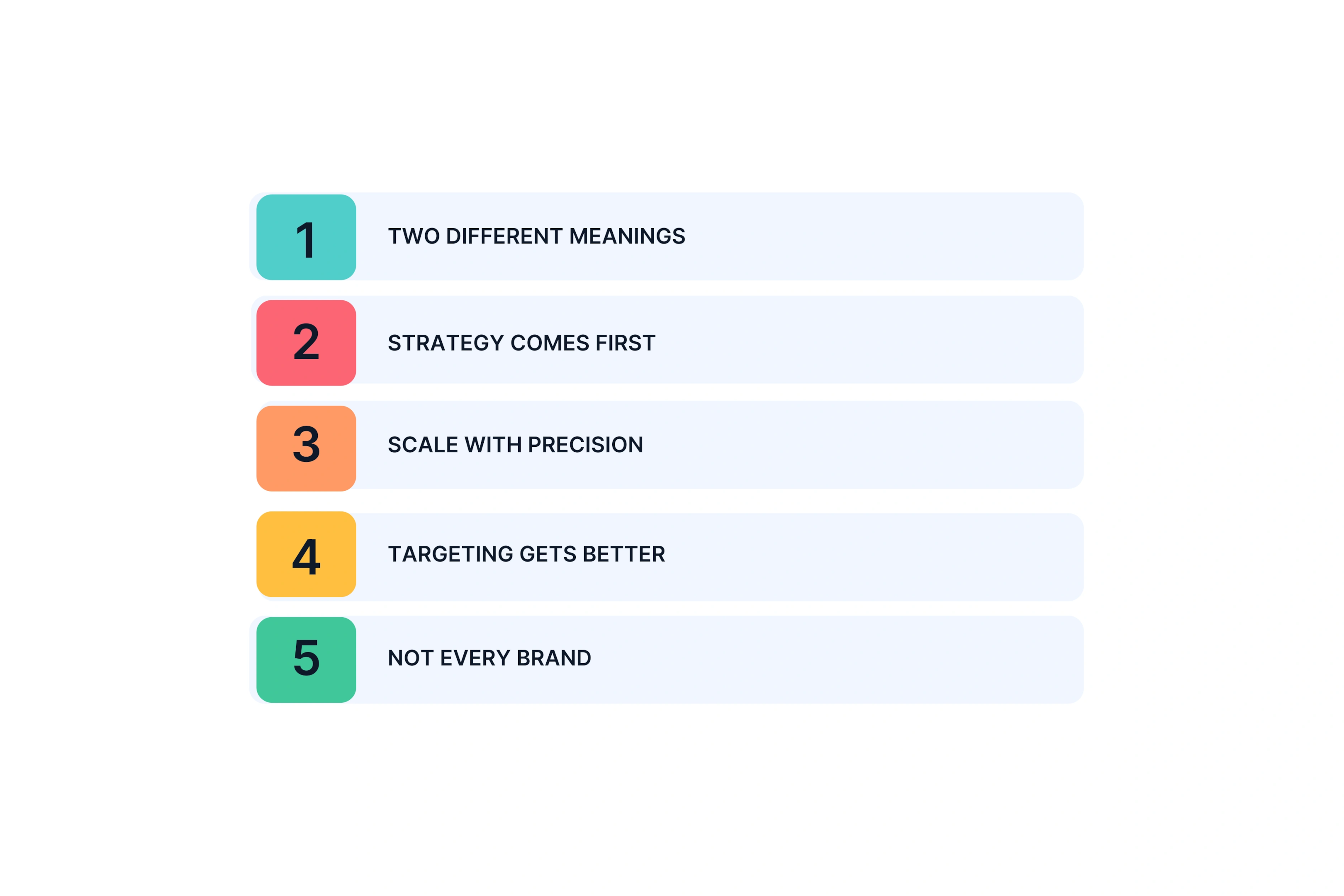
Two Different Meanings: Avatar marketing refers to digital AI avatars used in video content and customer avatars that define your ideal buyer profile.
Scale With Precision: Digital avatars work best for personalized video production at scale when you already know your audience and their pain points.
Targeting Gets Better: Customer avatars improve all your marketing efforts by mapping behaviors, preferences, and where your target audience spends time.
Not Every Brand: You do not need AI avatars just because they exist. Success depends on matching the approach to your business goals and brand identity.
Why "Avatar Marketing" Means Two Different Things (And Why That Matters)
The confusion is real. Search for avatar marketing and you get AI characters mixed with customer profiling guides.
Digital Avatars: The Execution Side
These are AI-generated characters that appear in your videos and ads. Think virtual influencers like Lil Miquela or AI spokesperson video services for product demos.
UGC-style content that feels authentic but does not require filming real people
Localized campaigns where one avatar speaks multiple languages
Quality matters here. Form realism means how human the avatar looks. Behavioral realism means how human it acts. Mismatch the two and your audience will notice.
Customer Avatars: The Strategy Side
This is a detailed profile of your ideal customer. You map their demographics, pain points, buying behavior, and where they spend time online.
You might hear it called a buyer persona or ideal customer profile. Same idea. This profile guides your messaging, platform selection, and content themes.
Why the Confusion Exists
Academic research uses "avatar marketing" to describe digital avatars in campaigns. Marketing agencies and practitioners use "customer avatar" for audience profiling work. Both groups are correct. The terms just serve different purposes in your strategy.
Here is the key difference: Digital avatars are tools you use. Customer avatars are the blueprint that tells you when and how to use those tools. That blueprint pays off: campaigns built on detailed customer personas see up to 2–3× higher conversion rates and significantly lower cost per acquisition compared to generic, assumption‑based messaging. Strategy before execution always wins.
Do You Need Digital Avatars, Customer Avatars, or Both? (Decision Framework)
Most brands rush into digital avatars without doing the essential first step. Here is how to determine what you actually need.
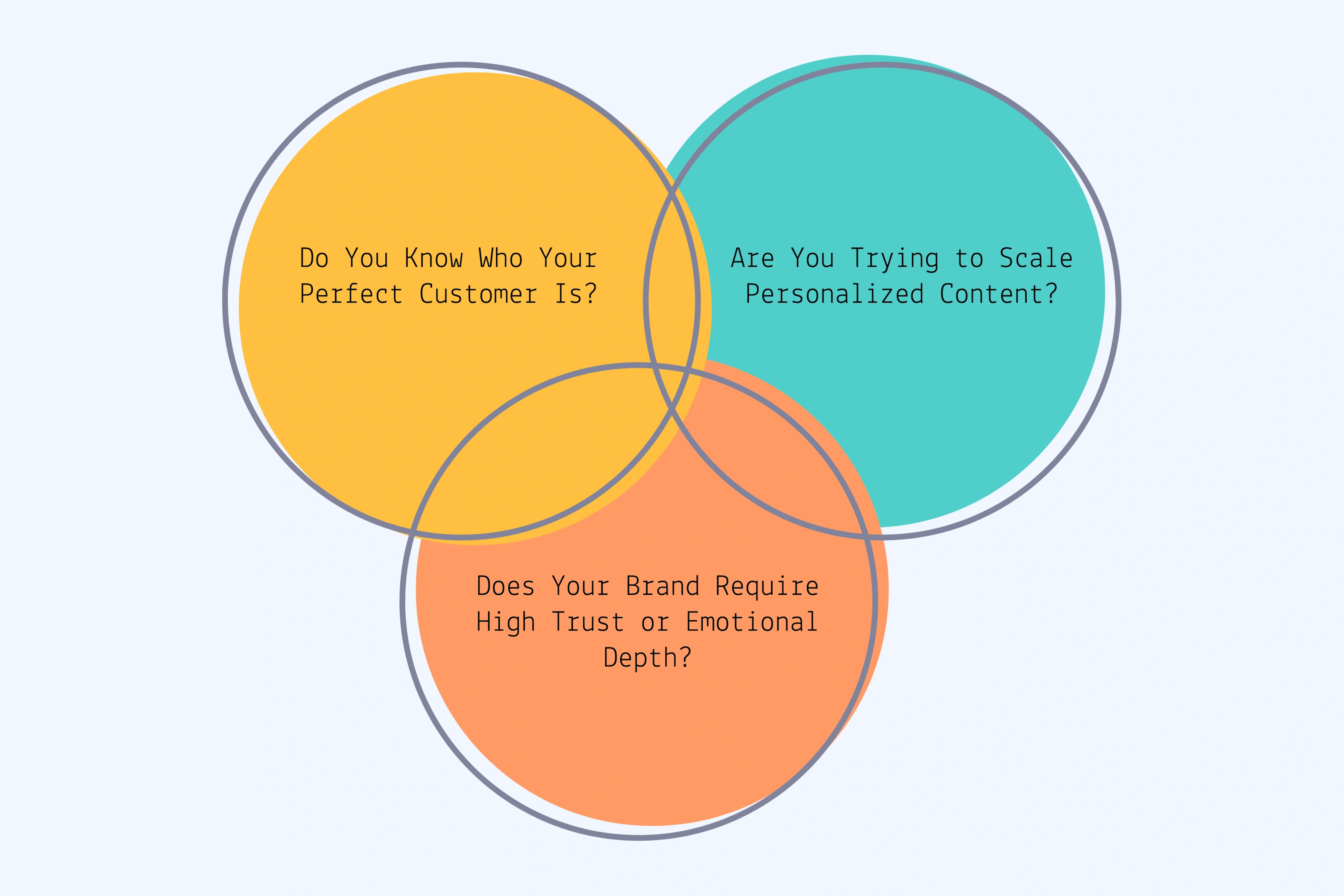
Start Here: Do You Know Who Your Perfect Customer Is?
Your ideal customer avatar is the foundation of business success. If you cannot describe your perfect customer in detail, you need customer avatar work before anything else.
This means knowing:
Demographics like age, location, gender, and income
Pain points and challenges they face every day
Where they search for solutions and engage with content
If YES: You have clarity. Move to the next question.
Are You Trying to Scale Personalized Content?
Digital avatars help you create personalized video at scale. But only if you already know who you are creating for and what messaging works.
If YES and you have customer clarity: Custom AI avatar video services might fit your needs. You can tailor content to different segments and explore advertising on multiple platforms.
If YES but targeting is unclear: Fix your ideal customer avatar first. Scaling the wrong message to the wrong audience wastes money fast.
If NO: You probably do not need digital avatars yet. Focus on developing stronger connections through other services and content types.
Does Your Brand Require High Trust or Emotional Depth?
Some industries need human interaction and emotional depth. Others benefit from speed and ability to scale.
High trust brands (luxury, B2B services, healthcare, financial): Digital avatars carry higher risk. Your audience expects real people and genuine characteristics in your marketing.
High volume brands (ecommerce, D2C products): Brand safe AI avatars are a safer bet. Speed and scale matter more than emotional storytelling.
Decision-making process and what influences their choices
Psychographics like values, fears, and aspirations
Example: "Agency Eric" is not just a marketing director. He fears his team wasting time on tools that do not deliver ROI. He searches for proof before buying. He values speed over perfection.
That level of detail changes how you create content and tailor your messaging.
How to Build Your Ideal Customer Avatar (Step-by-Step)
Step 1: Gather data from customer interviews, surveys, CRM analysis, website analytics, and sales team feedback. Real data beats assumptions every time.
Step 2: Identify patterns in your best customers. What do they have in common? Use quantitative research for numbers and qualitative insights for context.
Step 3: Document pain points and goals. What problem does your product solve? What are they trying to achieve in their business or life?
Step 4: Map behaviors and platforms. Where do they consume content? What platforms play a role in their decision process?
Step 5: Create 2 to 4 detailed profiles. Most businesses serve multiple customer segments.
Critical mistake: Building avatars on assumptions leads to misaligned messaging and wasted ad spend. Always start with real customer data.
How Customer Avatars Improve Your Marketing Efforts
Stronger messaging speaks directly to pain points your audience already feels. Content creation becomes easier because you know what topics resonate, what tone to use, and what format works best.
Example: An ecommerce brand used customer avatar research to determine TikTok over LinkedIn, casual tone over formal, and which product features to emphasize in ads.
Result: higher engagement, better conversion rates, and improved ROI across all marketing efforts.
When Digital Avatars Make Strategic Sense (And When They Don't)
Digital avatars are not essential for every business. The key is knowing when they enhance your marketing and when they hurt it.
The Form Realism and Behavioral Realism Framework
Two elements determine whether your avatar succeeds or fails.
Form realism is how human the avatar looks. Behavioral realism is how human it acts during interactions with your audience.
Research shows misalignment creates the uncanny valley effect. High form realism with robotic behavior triggers distrust. Your audience feels something is off even if they cannot explain why.
Practical example: A hyper-realistic avatar needs natural characteristics. It should respond like a real person would, show relevant emotions, and engage in a conversational tone.
Simplistic avatars follow different rules. Cartoonish characters set lower expectations. Your audience accepts simpler interactions because the visual style signals "this is synthetic." Platforms like Second Life proved this years ago.
Match form to behavior. That creates brand safe AI avatars that support your business goals instead of undermining them.
Personalized videos at scale: Creating thousands of videos for email or WhatsApp campaigns. Personalization pays: campaigns using personalized video report 2–3× higher open rates and 20–30% higher conversion rates compared to generic video or static content. Each viewer gets content tailored to their name, location, interests, and past behavior. This approach drives better engagement without filming thousands of versions.
Localized content without reshooting: One avatar delivers your brand message in multiple languages. Companies use AI video localization services to develop campaigns for different markets while maintaining consistency. Production costs drop while reach expands.
Product demos and explainer content: Services like AI spokesperson video services help ecommerce brands show how products work. Authenticity expectations are lower here. Speed and clarity matter more than emotional connection.
Training and internal use: L&D teams explore custom AI avatar video services for onboarding and compliance. Avatars deliver consistent messaging across locations and time zones.
Common thread: high volume, efficiency, and consistency over storytelling that requires human touch.
When to Avoid Digital Avatars
Some scenarios require real people. Using avatars in the wrong context damages your brand identity and customer relationships.
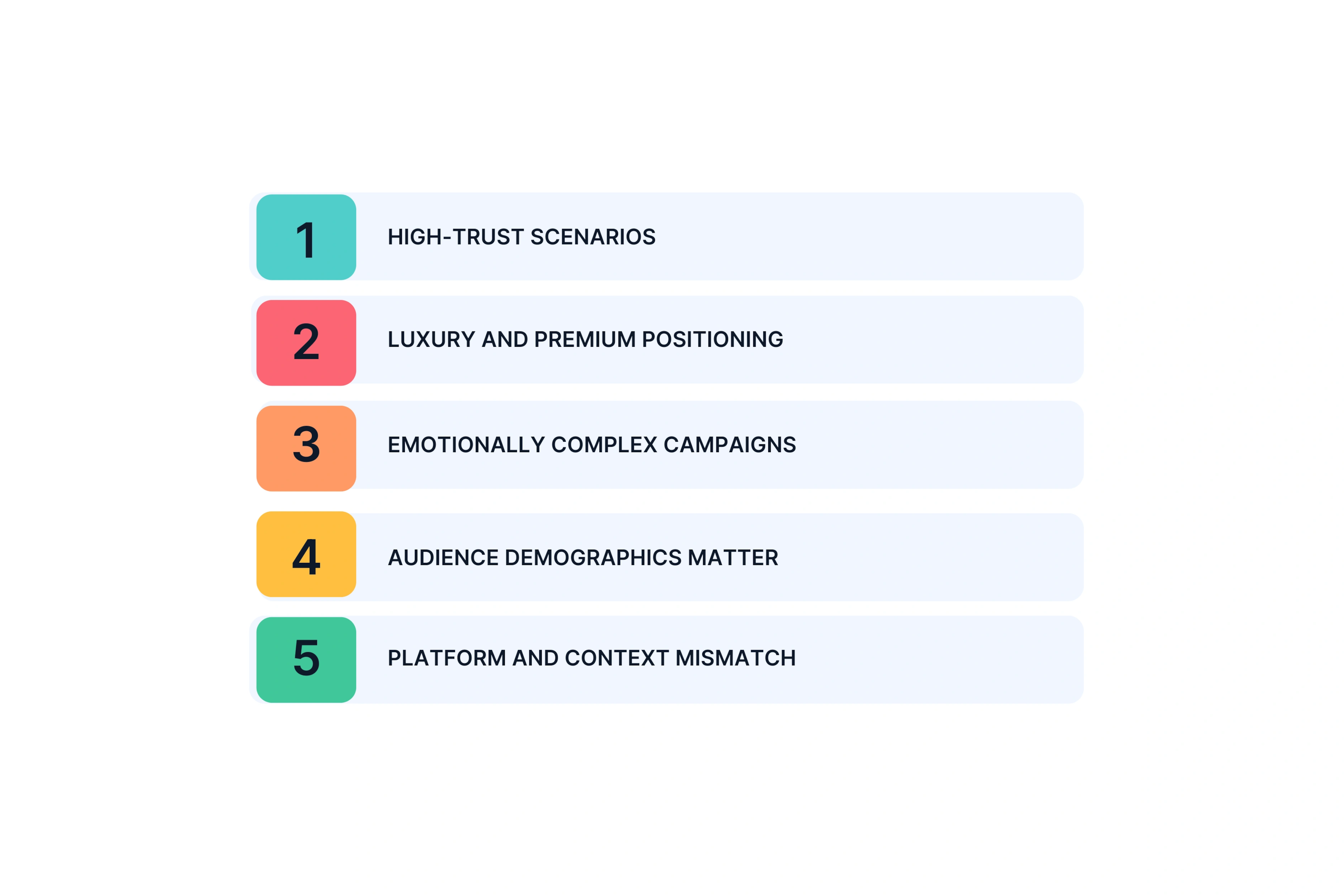
High-trust scenarios: Financial services, healthcare, and legal industries depend on human interactions. Sales in these fields require personal connection. Avatars cannot replicate the trust clients need before making life-changing decisions.
Luxury and premium positioning: Brands built on exclusivity and craftsmanship should avoid synthetic characters. Avatars cheapen the perception of quality and care that drives premium pricing.
Emotionally complex campaigns: Stories requiring empathy, nuance, or authentic human experience fall flat with digital characters. Creating emotional connections demands real people with real expressions.
Audience demographics matter: Older consumers in certain markets show low acceptance of virtual influencers. Gender, age, and cultural context influence how people respond to synthetic characters. Test before you scale.
Platform and context mismatch: LinkedIn for senior executives needs different approaches than TikTok for Gen Z. A gaming company might succeed with avatars on social platforms but fail using them in B2B sales meetings.
Explore where your audience spends time and what they expect. That determines whether digital avatars enhance or hurt your marketing efforts.
The Hidden Risks of Avatar Marketing (That No One Talks About)
Most content on avatar marketing only covers the benefits. Here are the real risks that can hurt your business.
Digital Avatars: The Authenticity Tax
Audiences are getting better at spotting AI avatars. Consumer experience research shows people notice robotic movements, unnatural speech patterns, and mismatched expressions.
The "good enough" trap is real. Low-cost digital avatars save money upfront but damage long-term brand perception. Your audience remembers bad experiences. They associate that quality with your company.
Mitigation strategy: Test avatars in low-stakes scenarios first. Use them in email campaigns or internal training before deploying in high-visibility ads. Gather data on how your target audience responds. Adjust quality and style based on real feedback.
Customer Avatars: The Assumption Trap
Building ideal customer avatars without real data means you are marketing to imaginary people. This leads to misaligned messaging, wasted advertising budget, and campaigns that do not resonate.
Validation is essential. Customer avatars should evolve as you gather more customer behavior data. They are not static documents you create once and forget. Market research should inform updates every quarter.
Example: An ecommerce brand assumed their ideal customer cared about sustainability. Sales data showed price mattered more. They wasted six months on the wrong messaging before checking the data.
The Hype Cycle Problem
Avatar marketing is in peak hype right now. Lots of tools make big promises. Lots of brands rush to adopt without strategic fit.
This creates three risks: budget waste on tools you do not need, brand misalignment when avatars do not match your positioning, and audience backlash when execution feels forced.
Better approach: Slow, strategic adoption based on business goals and customer data. Not trend-chasing.
Cultural and Ethical Considerations
Virtual influencers and AI avatars raise transparency questions. Audiences want to know when they are engaging with AI. Some markets have stronger expectations for human interaction and genuine connections.
Respect those preferences. Disclose when using digital avatars, especially in sensitive or high-trust contexts like healthcare, financial services, or life decisions. Transparency builds trust. Hiding it destroys it.
How Successful Brands Use Both Customer Avatars and Digital Avatars Together
The best results come from combining strategy and execution. Here are three real-world patterns that work.
Case Pattern 1: E-Commerce Personalization
An online retailer started with customer avatar research. They identified three segments: budget-conscious shoppers, luxury seekers, and eco-conscious buyers.
They used customer avatar data to create personalized product videos with digital avatars. Each segment got messaging tailored to their specific pain points.
Key success factor: Customer avatar insights informed which products to feature, what messaging to use, and which platforms delivered the best ROI. Strategy guided execution at every step.
Case Pattern 2: D2C Global Expansion
A direct-to-consumer brand launched in five markets. They started with customer avatar research to understand cultural differences and local buying behavior.
They created one digital avatar but adapted behavioral realism and messaging per market. The avatar maintained brand identity while respecting local consumer expectations.
Results:
70 percent reduction in production costs versus traditional video
Consistent brand message across all markets
Faster time to market in new regions
Key success factor: Customer avatars revealed which markets valued efficiency over authenticity. This guided where to use digital avatars and where to invest in local partnerships instead.
Case Pattern 3: Creative Agencies Serving Clients
A marketing agency builds detailed customer avatars for each client. They gather data on the client's ideal customer before creating any content.
Then they use custom AI avatar video services to deliver UGC-style content quickly. This positions them as a strategic partner with a consultative approach, not just a production vendor.
Key success factor: Customer avatar work first means messaging that resonates. Digital avatars provide scalable execution once the strategy is proven.
Common success thread: All three patterns start with customer avatar clarity. Digital avatars come second, deployed strategically based on that foundation.
Building Your Avatar Marketing Strategy: The Practical Playbook
Here is a step-by-step approach you can follow. Save this section and use it as your roadmap.
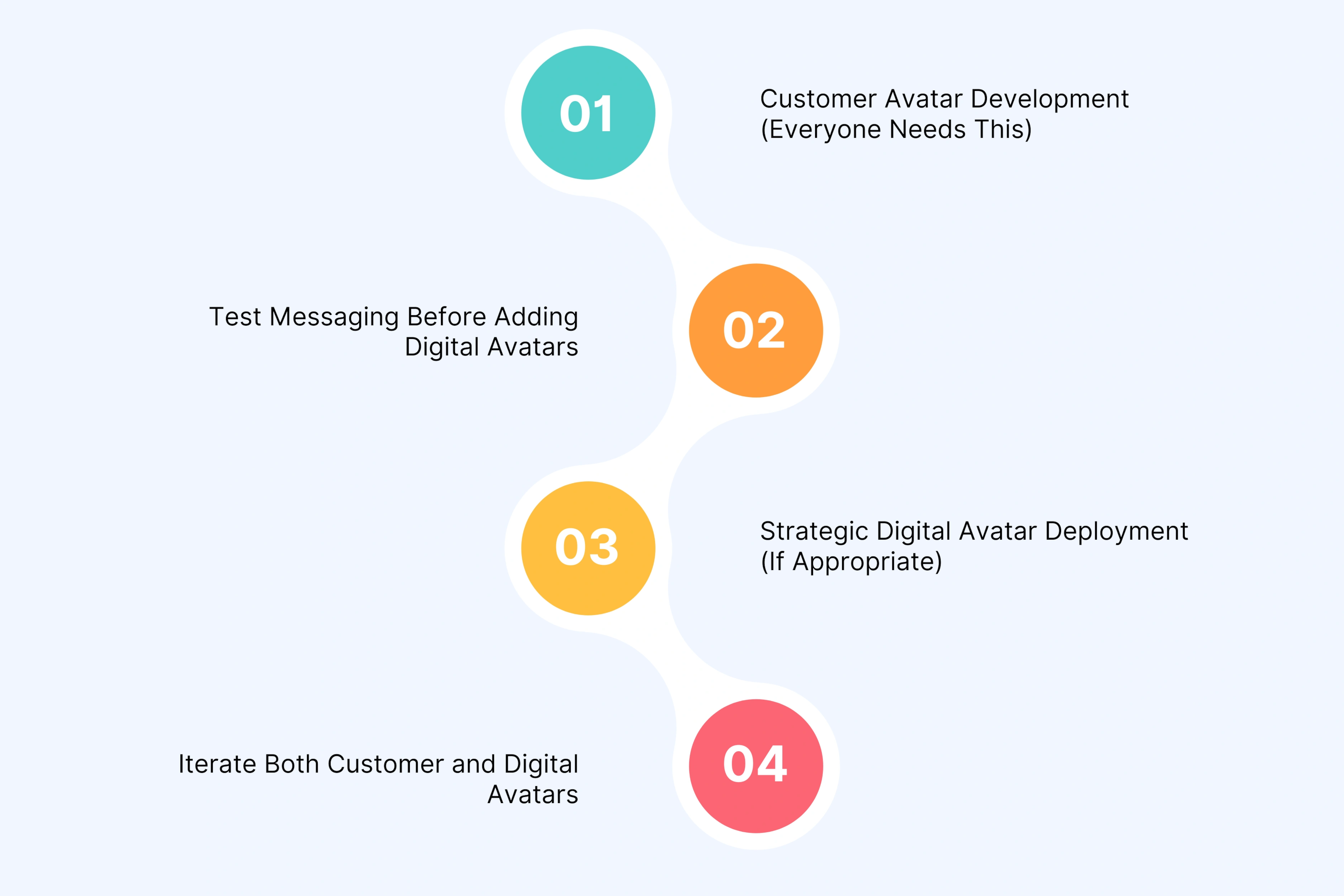
Phase 1: Customer Avatar Development (Everyone Needs This)
Week 1-2: Conduct market research. Interview 5 to 10 past customers. Survey your existing audience. Analyze CRM data and website analytics to identify patterns in customer behavior.
Week 3: Create 2 to 4 customer avatar profiles. Include demographics, psychographics, pain points, goals, information sources, and buying triggers. Be specific. "Marketing manager who fears wasting budget" beats "B2B professional."
Week 4: Validate your avatars. Test messaging with real customers. Adjust based on their feedback. Do not skip this step.
Deliverable: Detailed customer avatar documents that inform all your marketing decisions moving forward.
Phase 2: Test Messaging Before Adding Digital Avatars
Create content based on customer avatar insights. Write blogs, social posts, and email campaigns that speak directly to pain points you identified.
Measure engagement rates, conversion, and feedback quality. Are you resonating with your target audience? Does the data show improvement?
Refine messaging based on results. This costs less than fixing digital avatar campaigns later.
Decision point: If messaging works, consider digital avatars for scale. If not, iterate on customer avatars first.
Phase 3: Strategic Digital Avatar Deployment (If Appropriate)
Start small with low-risk scenarios. Use avatars in email campaigns, website explainers, or internal training before launching public ads.
Ensure form and behavioral realism alignment. Match avatar sophistication to audience expectations and your brand identity.
Test and measure consumer engagement, brand perception, and conversion rates. Compare avatar content to non-avatar content.
Scale gradually. Expand to ads and social media only after proving effectiveness in controlled tests.
Ongoing: Iterate Both Customer and Digital Avatars
Customer avatars: Update quarterly as you gather more customer data and market research. Buying behavior changes. Your avatars should too.
Digital avatars: Refine based on performance metrics and audience feedback. Technology improves, so your execution should improve.
A/B testing: Create multiple versions of content to determine what works best. Test different messaging, platforms, and avatar styles. Let data guide your decisions.
How a Creative Partner Approach Simplifies Avatar Marketing
Most brands struggle to execute avatar marketing well internally. Here is why and how the right partner model solves it.
Why Brands Struggle Internally
Customer avatar development takes time, research expertise, and willingness to challenge assumptions. Your team needs to conduct interviews, analyze data, and identify patterns without bias.
Digital avatar production requires technical knowledge. You need to understand form and behavioral realism alignment, content creation skills, and strategic implementation that matches your brand identity.
The gap: Most marketing teams lack bandwidth for comprehensive customer avatar research AND digital avatar execution. You can do one or the other. Rarely both at the level needed for business success.
What a Creative Partner Model Offers
For customer avatars: A structured research process combining quantitative data and qualitative insights. An unbiased outside perspective helps identify patterns your internal team might miss.
For digital avatars: End-to-end production from script to final video. Strategic guidance on when to use avatars versus when to avoid them. Quality control that prevents uncanny valley problems and ensures brand fit.
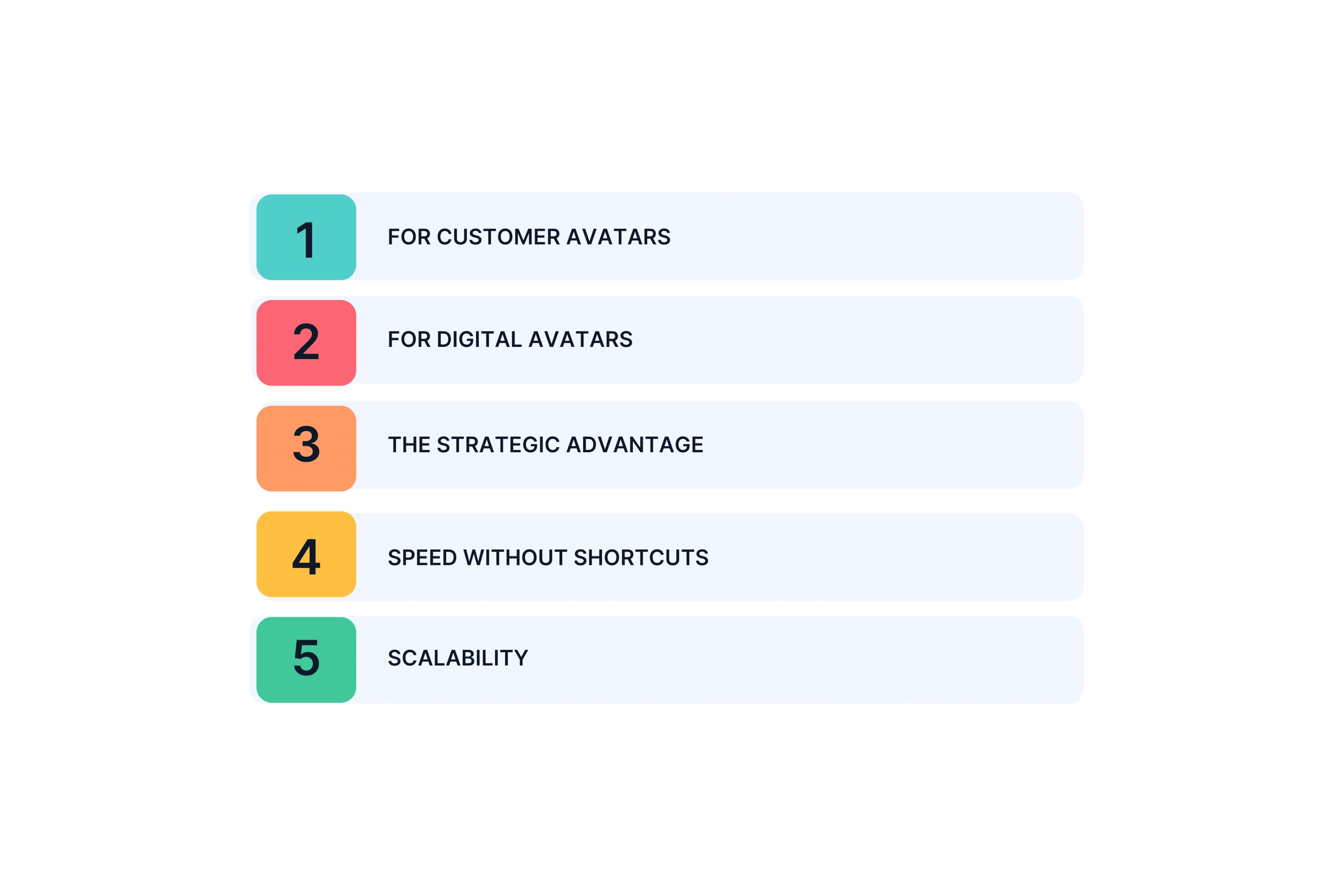
The strategic advantage: Partners who handle both customer avatar insights and digital avatar execution ensure alignment. Your strategy informs execution at every step.
Speed without shortcuts: Faster turnaround than traditional agencies. You get finished videos in hours or days, not weeks. More strategic than self-service tools because you receive consultative recommendations, not just access to software.
Scalability: The ability to create multiple versions for A/B testing, personalized messaging, and localized campaigns based on your customer avatar segments.
Key Difference from DIY or Agency Models
DIY tools lack strategic guidance. You risk poor execution or misalignment with brand identity.
Traditional agencies are slow and expensive. Customer avatar research can take months. Video production takes weeks.
Creative partner model: Strategic plus fast plus cost-effective plus consultative.
When This Model Works Best
This approach delivers the most value for:
D2C brands scaling content creation across multiple customer segments
E-commerce teams needing personalized video production at scale for email and ad campaigns
Creative agencies serving clients who need both customer insights and digital content
Brands with clear business goals but lacking internal avatar marketing expertise
The right creative partner bridges strategy and execution so you can focus on running your business.
What This Means for Teams Trying to Scale Video Content
Avatar marketing is not a trend to chase. It is a set of tools to evaluate against your business goals.
Ask yourself: Do you have clear customer avatar profiles based on real data? Are you trying to scale content limited by time or cost? Does your brand identity align with AI-generated content?
Start with customer avatar clarity. This improves all marketing, not just avatar content. Test digital avatars in low-risk scenarios before scaling.
The best avatar marketing delivers the right message to the right target audience at the right scale.
Avatar marketing has two meanings. First, it refers to using digital AI avatars like virtual influencers in video content and ads. Second, it means creating customer avatars, which are detailed profiles of your ideal customer for better targeting. Most brands need customer avatar clarity before using digital avatars.
What's the difference between a customer avatar and a buyer persona?
These terms mean the same thing. Both describe your ideal customer. Customer avatar often includes emotional depth like pain points and fears. Buyer persona may focus more on demographics and how people make decisions. Both improve your targeting and messaging.
How do I create an ideal customer avatar?
Start with real data. Conduct customer interviews. Analyze your CRM and website analytics. Survey your audience. Look for patterns in demographics and psychographics. Document pain points and buying triggers. Validate with customer feedback. Create 2 to 4 profiles for different segments. Update quarterly.
When should I use digital avatars in my marketing?
Use digital avatars for scaling personalized content, localized campaigns without reshooting, product demos, and high-volume content needs. Avoid them in high-trust scenarios like financial or healthcare marketing, luxury positioning, emotionally complex storytelling, or when your audience has low AI acceptance.
What are form realism and behavioral realism?
Form realism is how human the avatar looks. Behavioral realism is how human it acts. Misalignment causes problems. Hyper-realistic avatars with robotic behavior trigger the uncanny valley effect and reduce trust. Match the avatar's sophistication to what your audience expects.
Are digital avatars effective for B2B marketing?
Yes, but use caution. Digital avatars work for explainer videos, product demos, training content, and internal communications. They are less effective for senior-level outreach, relationship-building, and high-stakes proposals. Test in lower-stakes scenarios first. Measure brand perception alongside conversion.
How much does avatar marketing cost?
Costs vary widely. Customer avatar development costs relatively little, mainly research time. Digital avatar content ranges from affordable through a creative partner delivering videos in days to expensive custom 3D development taking weeks. Best ROI comes from reusing one avatar across multiple campaigns.
What's the biggest mistake brands make with avatar marketing?
Deploying digital avatars without customer avatar clarity. Brands rush to use AI content because it is trendy. Without understanding their ideal customer's pain points and behaviors, the content misses the mark. This wastes budget and lowers engagement. Build customer avatars first.
How do I measure success with avatar marketing?
For digital avatars, track engagement rates, conversion, brand perception surveys, and cost-efficiency versus traditional video. For customer avatars, monitor targeting accuracy, campaign ROI, message resonance, and customer acquisition cost. Both need ongoing data analysis and iteration based on customer behavior.
Should I disclose when I'm using AI avatars?
Yes, especially in high-trust contexts or when targeting audiences that value authenticity. Transparency builds consumer trust. Many audiences appreciate knowing when they engage with AI. Some platforms require disclosure. Frame it positively: "We use AI technology to deliver personalized content at scale."
Let's Turn Your Scripts into Stunning Videos. Sign Up Now.
Stop struggling with video creation. Our AI simplifies the process, letting you create professional-looking videos from text in record time. Try it for free today!
Avatar Marketing: Which One Do You Actually Need? (And How to Know)
Avatar marketing can mean digital AI characters OR customer profiling. Learn which one you need, when each works, and how to avoid costly mistakes in your strategy.
If you searched for "avatar marketing," you probably found two different answers.
Some results talk about AI characters in videos. Others explain customer profiles and buyer personas.
Both are correct. The term means two things.
One is about execution. The other is about strategy. Most brands need both, but in the right order.
This guide will help you figure out which type of avatar marketing fits your business. You will learn when digital avatars make sense, how to build customer avatars that improve targeting, and how to avoid wasting money on the wrong approach first.
Key Takeaways
Two Different Meanings: Avatar marketing refers to digital AI avatars used in video content and customer avatars that define your ideal buyer profile.
Scale With Precision: Digital avatars work best for personalized video production at scale when you already know your audience and their pain points.
Targeting Gets Better: Customer avatars improve all your marketing efforts by mapping behaviors, preferences, and where your target audience spends time.
Not Every Brand: You do not need AI avatars just because they exist. Success depends on matching the approach to your business goals and brand identity.
Why "Avatar Marketing" Means Two Different Things (And Why That Matters)
The confusion is real. Search for avatar marketing and you get AI characters mixed with customer profiling guides.
Digital Avatars: The Execution Side
These are AI-generated characters that appear in your videos and ads. Think virtual influencers like Lil Miquela or AI spokesperson video services for product demos.
UGC-style content that feels authentic but does not require filming real people
Localized campaigns where one avatar speaks multiple languages
Quality matters here. Form realism means how human the avatar looks. Behavioral realism means how human it acts. Mismatch the two and your audience will notice.
Customer Avatars: The Strategy Side
This is a detailed profile of your ideal customer. You map their demographics, pain points, buying behavior, and where they spend time online.
You might hear it called a buyer persona or ideal customer profile. Same idea. This profile guides your messaging, platform selection, and content themes.
Why the Confusion Exists
Academic research uses "avatar marketing" to describe digital avatars in campaigns. Marketing agencies and practitioners use "customer avatar" for audience profiling work. Both groups are correct. The terms just serve different purposes in your strategy.
Here is the key difference: Digital avatars are tools you use. Customer avatars are the blueprint that tells you when and how to use those tools. That blueprint pays off: campaigns built on detailed customer personas see up to 2–3× higher conversion rates and significantly lower cost per acquisition compared to generic, assumption‑based messaging. Strategy before execution always wins.
Do You Need Digital Avatars, Customer Avatars, or Both? (Decision Framework)
Most brands rush into digital avatars without doing the essential first step. Here is how to determine what you actually need.
Start Here: Do You Know Who Your Perfect Customer Is?
Your ideal customer avatar is the foundation of business success. If you cannot describe your perfect customer in detail, you need customer avatar work before anything else.
This means knowing:
Demographics like age, location, gender, and income
Pain points and challenges they face every day
Where they search for solutions and engage with content
If YES: You have clarity. Move to the next question.
Are You Trying to Scale Personalized Content?
Digital avatars help you create personalized video at scale. But only if you already know who you are creating for and what messaging works.
If YES and you have customer clarity: Custom AI avatar video services might fit your needs. You can tailor content to different segments and explore advertising on multiple platforms.
If YES but targeting is unclear: Fix your ideal customer avatar first. Scaling the wrong message to the wrong audience wastes money fast.
If NO: You probably do not need digital avatars yet. Focus on developing stronger connections through other services and content types.
Does Your Brand Require High Trust or Emotional Depth?
Some industries need human interaction and emotional depth. Others benefit from speed and ability to scale.
High trust brands (luxury, B2B services, healthcare, financial): Digital avatars carry higher risk. Your audience expects real people and genuine characteristics in your marketing.
High volume brands (ecommerce, D2C products): Brand safe AI avatars are a safer bet. Speed and scale matter more than emotional storytelling.
Decision-making process and what influences their choices
Psychographics like values, fears, and aspirations
Example: "Agency Eric" is not just a marketing director. He fears his team wasting time on tools that do not deliver ROI. He searches for proof before buying. He values speed over perfection.
That level of detail changes how you create content and tailor your messaging.
How to Build Your Ideal Customer Avatar (Step-by-Step)
Step 1: Gather data from customer interviews, surveys, CRM analysis, website analytics, and sales team feedback. Real data beats assumptions every time.
Step 2: Identify patterns in your best customers. What do they have in common? Use quantitative research for numbers and qualitative insights for context.
Step 3: Document pain points and goals. What problem does your product solve? What are they trying to achieve in their business or life?
Step 4: Map behaviors and platforms. Where do they consume content? What platforms play a role in their decision process?
Step 5: Create 2 to 4 detailed profiles. Most businesses serve multiple customer segments.
Critical mistake: Building avatars on assumptions leads to misaligned messaging and wasted ad spend. Always start with real customer data.
How Customer Avatars Improve Your Marketing Efforts
Stronger messaging speaks directly to pain points your audience already feels. Content creation becomes easier because you know what topics resonate, what tone to use, and what format works best.
Example: An ecommerce brand used customer avatar research to determine TikTok over LinkedIn, casual tone over formal, and which product features to emphasize in ads.
Result: higher engagement, better conversion rates, and improved ROI across all marketing efforts.
When Digital Avatars Make Strategic Sense (And When They Don't)
Digital avatars are not essential for every business. The key is knowing when they enhance your marketing and when they hurt it.
The Form Realism and Behavioral Realism Framework
Two elements determine whether your avatar succeeds or fails.
Form realism is how human the avatar looks. Behavioral realism is how human it acts during interactions with your audience.
Research shows misalignment creates the uncanny valley effect. High form realism with robotic behavior triggers distrust. Your audience feels something is off even if they cannot explain why.
Practical example: A hyper-realistic avatar needs natural characteristics. It should respond like a real person would, show relevant emotions, and engage in a conversational tone.
Simplistic avatars follow different rules. Cartoonish characters set lower expectations. Your audience accepts simpler interactions because the visual style signals "this is synthetic." Platforms like Second Life proved this years ago.
Match form to behavior. That creates brand safe AI avatars that support your business goals instead of undermining them.
Personalized videos at scale: Creating thousands of videos for email or WhatsApp campaigns. Personalization pays: campaigns using personalized video report 2–3× higher open rates and 20–30% higher conversion rates compared to generic video or static content. Each viewer gets content tailored to their name, location, interests, and past behavior. This approach drives better engagement without filming thousands of versions.
Localized content without reshooting: One avatar delivers your brand message in multiple languages. Companies use AI video localization services to develop campaigns for different markets while maintaining consistency. Production costs drop while reach expands.
Product demos and explainer content: Services like AI spokesperson video services help ecommerce brands show how products work. Authenticity expectations are lower here. Speed and clarity matter more than emotional connection.
Training and internal use: L&D teams explore custom AI avatar video services for onboarding and compliance. Avatars deliver consistent messaging across locations and time zones.
Common thread: high volume, efficiency, and consistency over storytelling that requires human touch.
When to Avoid Digital Avatars
Some scenarios require real people. Using avatars in the wrong context damages your brand identity and customer relationships.
High-trust scenarios: Financial services, healthcare, and legal industries depend on human interactions. Sales in these fields require personal connection. Avatars cannot replicate the trust clients need before making life-changing decisions.
Luxury and premium positioning: Brands built on exclusivity and craftsmanship should avoid synthetic characters. Avatars cheapen the perception of quality and care that drives premium pricing.
Emotionally complex campaigns: Stories requiring empathy, nuance, or authentic human experience fall flat with digital characters. Creating emotional connections demands real people with real expressions.
Audience demographics matter: Older consumers in certain markets show low acceptance of virtual influencers. Gender, age, and cultural context influence how people respond to synthetic characters. Test before you scale.
Platform and context mismatch: LinkedIn for senior executives needs different approaches than TikTok for Gen Z. A gaming company might succeed with avatars on social platforms but fail using them in B2B sales meetings.
Explore where your audience spends time and what they expect. That determines whether digital avatars enhance or hurt your marketing efforts.
The Hidden Risks of Avatar Marketing (That No One Talks About)
Most content on avatar marketing only covers the benefits. Here are the real risks that can hurt your business.
Digital Avatars: The Authenticity Tax
Audiences are getting better at spotting AI avatars. Consumer experience research shows people notice robotic movements, unnatural speech patterns, and mismatched expressions.
The "good enough" trap is real. Low-cost digital avatars save money upfront but damage long-term brand perception. Your audience remembers bad experiences. They associate that quality with your company.
Mitigation strategy: Test avatars in low-stakes scenarios first. Use them in email campaigns or internal training before deploying in high-visibility ads. Gather data on how your target audience responds. Adjust quality and style based on real feedback.
Customer Avatars: The Assumption Trap
Building ideal customer avatars without real data means you are marketing to imaginary people. This leads to misaligned messaging, wasted advertising budget, and campaigns that do not resonate.
Validation is essential. Customer avatars should evolve as you gather more customer behavior data. They are not static documents you create once and forget. Market research should inform updates every quarter.
Example: An ecommerce brand assumed their ideal customer cared about sustainability. Sales data showed price mattered more. They wasted six months on the wrong messaging before checking the data.
The Hype Cycle Problem
Avatar marketing is in peak hype right now. Lots of tools make big promises. Lots of brands rush to adopt without strategic fit.
This creates three risks: budget waste on tools you do not need, brand misalignment when avatars do not match your positioning, and audience backlash when execution feels forced.
Better approach: Slow, strategic adoption based on business goals and customer data. Not trend-chasing.
Cultural and Ethical Considerations
Virtual influencers and AI avatars raise transparency questions. Audiences want to know when they are engaging with AI. Some markets have stronger expectations for human interaction and genuine connections.
Respect those preferences. Disclose when using digital avatars, especially in sensitive or high-trust contexts like healthcare, financial services, or life decisions. Transparency builds trust. Hiding it destroys it.
How Successful Brands Use Both Customer Avatars and Digital Avatars Together
The best results come from combining strategy and execution. Here are three real-world patterns that work.
Case Pattern 1: E-Commerce Personalization
An online retailer started with customer avatar research. They identified three segments: budget-conscious shoppers, luxury seekers, and eco-conscious buyers.
They used customer avatar data to create personalized product videos with digital avatars. Each segment got messaging tailored to their specific pain points.
Key success factor: Customer avatar insights informed which products to feature, what messaging to use, and which platforms delivered the best ROI. Strategy guided execution at every step.
Case Pattern 2: D2C Global Expansion
A direct-to-consumer brand launched in five markets. They started with customer avatar research to understand cultural differences and local buying behavior.
They created one digital avatar but adapted behavioral realism and messaging per market. The avatar maintained brand identity while respecting local consumer expectations.
Results:
70 percent reduction in production costs versus traditional video
Consistent brand message across all markets
Faster time to market in new regions
Key success factor: Customer avatars revealed which markets valued efficiency over authenticity. This guided where to use digital avatars and where to invest in local partnerships instead.
Case Pattern 3: Creative Agencies Serving Clients
A marketing agency builds detailed customer avatars for each client. They gather data on the client's ideal customer before creating any content.
Then they use custom AI avatar video services to deliver UGC-style content quickly. This positions them as a strategic partner with a consultative approach, not just a production vendor.
Key success factor: Customer avatar work first means messaging that resonates. Digital avatars provide scalable execution once the strategy is proven.
Common success thread: All three patterns start with customer avatar clarity. Digital avatars come second, deployed strategically based on that foundation.
Building Your Avatar Marketing Strategy: The Practical Playbook
Here is a step-by-step approach you can follow. Save this section and use it as your roadmap.
Phase 1: Customer Avatar Development (Everyone Needs This)
Week 1-2: Conduct market research. Interview 5 to 10 past customers. Survey your existing audience. Analyze CRM data and website analytics to identify patterns in customer behavior.
Week 3: Create 2 to 4 customer avatar profiles. Include demographics, psychographics, pain points, goals, information sources, and buying triggers. Be specific. "Marketing manager who fears wasting budget" beats "B2B professional."
Week 4: Validate your avatars. Test messaging with real customers. Adjust based on their feedback. Do not skip this step.
Deliverable: Detailed customer avatar documents that inform all your marketing decisions moving forward.
Phase 2: Test Messaging Before Adding Digital Avatars
Create content based on customer avatar insights. Write blogs, social posts, and email campaigns that speak directly to pain points you identified.
Measure engagement rates, conversion, and feedback quality. Are you resonating with your target audience? Does the data show improvement?
Refine messaging based on results. This costs less than fixing digital avatar campaigns later.
Decision point: If messaging works, consider digital avatars for scale. If not, iterate on customer avatars first.
Phase 3: Strategic Digital Avatar Deployment (If Appropriate)
Start small with low-risk scenarios. Use avatars in email campaigns, website explainers, or internal training before launching public ads.
Ensure form and behavioral realism alignment. Match avatar sophistication to audience expectations and your brand identity.
Test and measure consumer engagement, brand perception, and conversion rates. Compare avatar content to non-avatar content.
Scale gradually. Expand to ads and social media only after proving effectiveness in controlled tests.
Ongoing: Iterate Both Customer and Digital Avatars
Customer avatars: Update quarterly as you gather more customer data and market research. Buying behavior changes. Your avatars should too.
Digital avatars: Refine based on performance metrics and audience feedback. Technology improves, so your execution should improve.
A/B testing: Create multiple versions of content to determine what works best. Test different messaging, platforms, and avatar styles. Let data guide your decisions.
How a Creative Partner Approach Simplifies Avatar Marketing
Most brands struggle to execute avatar marketing well internally. Here is why and how the right partner model solves it.
Why Brands Struggle Internally
Customer avatar development takes time, research expertise, and willingness to challenge assumptions. Your team needs to conduct interviews, analyze data, and identify patterns without bias.
Digital avatar production requires technical knowledge. You need to understand form and behavioral realism alignment, content creation skills, and strategic implementation that matches your brand identity.
The gap: Most marketing teams lack bandwidth for comprehensive customer avatar research AND digital avatar execution. You can do one or the other. Rarely both at the level needed for business success.
What a Creative Partner Model Offers
For customer avatars: A structured research process combining quantitative data and qualitative insights. An unbiased outside perspective helps identify patterns your internal team might miss.
For digital avatars: End-to-end production from script to final video. Strategic guidance on when to use avatars versus when to avoid them. Quality control that prevents uncanny valley problems and ensures brand fit.
The strategic advantage: Partners who handle both customer avatar insights and digital avatar execution ensure alignment. Your strategy informs execution at every step.
Speed without shortcuts: Faster turnaround than traditional agencies. You get finished videos in hours or days, not weeks. More strategic than self-service tools because you receive consultative recommendations, not just access to software.
Scalability: The ability to create multiple versions for A/B testing, personalized messaging, and localized campaigns based on your customer avatar segments.
Key Difference from DIY or Agency Models
DIY tools lack strategic guidance. You risk poor execution or misalignment with brand identity.
Traditional agencies are slow and expensive. Customer avatar research can take months. Video production takes weeks.
Creative partner model: Strategic plus fast plus cost-effective plus consultative.
When This Model Works Best
This approach delivers the most value for:
D2C brands scaling content creation across multiple customer segments
E-commerce teams needing personalized video production at scale for email and ad campaigns
Creative agencies serving clients who need both customer insights and digital content
Brands with clear business goals but lacking internal avatar marketing expertise
The right creative partner bridges strategy and execution so you can focus on running your business.
What This Means for Teams Trying to Scale Video Content
Avatar marketing is not a trend to chase. It is a set of tools to evaluate against your business goals.
Ask yourself: Do you have clear customer avatar profiles based on real data? Are you trying to scale content limited by time or cost? Does your brand identity align with AI-generated content?
Start with customer avatar clarity. This improves all marketing, not just avatar content. Test digital avatars in low-risk scenarios before scaling.
The best avatar marketing delivers the right message to the right target audience at the right scale.
Avatar marketing has two meanings. First, it refers to using digital AI avatars like virtual influencers in video content and ads. Second, it means creating customer avatars, which are detailed profiles of your ideal customer for better targeting. Most brands need customer avatar clarity before using digital avatars.
What's the difference between a customer avatar and a buyer persona?
These terms mean the same thing. Both describe your ideal customer. Customer avatar often includes emotional depth like pain points and fears. Buyer persona may focus more on demographics and how people make decisions. Both improve your targeting and messaging.
How do I create an ideal customer avatar?
Start with real data. Conduct customer interviews. Analyze your CRM and website analytics. Survey your audience. Look for patterns in demographics and psychographics. Document pain points and buying triggers. Validate with customer feedback. Create 2 to 4 profiles for different segments. Update quarterly.
When should I use digital avatars in my marketing?
Use digital avatars for scaling personalized content, localized campaigns without reshooting, product demos, and high-volume content needs. Avoid them in high-trust scenarios like financial or healthcare marketing, luxury positioning, emotionally complex storytelling, or when your audience has low AI acceptance.
What are form realism and behavioral realism?
Form realism is how human the avatar looks. Behavioral realism is how human it acts. Misalignment causes problems. Hyper-realistic avatars with robotic behavior trigger the uncanny valley effect and reduce trust. Match the avatar's sophistication to what your audience expects.
Are digital avatars effective for B2B marketing?
Yes, but use caution. Digital avatars work for explainer videos, product demos, training content, and internal communications. They are less effective for senior-level outreach, relationship-building, and high-stakes proposals. Test in lower-stakes scenarios first. Measure brand perception alongside conversion.
How much does avatar marketing cost?
Costs vary widely. Customer avatar development costs relatively little, mainly research time. Digital avatar content ranges from affordable through a creative partner delivering videos in days to expensive custom 3D development taking weeks. Best ROI comes from reusing one avatar across multiple campaigns.
What's the biggest mistake brands make with avatar marketing?
Deploying digital avatars without customer avatar clarity. Brands rush to use AI content because it is trendy. Without understanding their ideal customer's pain points and behaviors, the content misses the mark. This wastes budget and lowers engagement. Build customer avatars first.
How do I measure success with avatar marketing?
For digital avatars, track engagement rates, conversion, brand perception surveys, and cost-efficiency versus traditional video. For customer avatars, monitor targeting accuracy, campaign ROI, message resonance, and customer acquisition cost. Both need ongoing data analysis and iteration based on customer behavior.
Should I disclose when I'm using AI avatars?
Yes, especially in high-trust contexts or when targeting audiences that value authenticity. Transparency builds consumer trust. Many audiences appreciate knowing when they engage with AI. Some platforms require disclosure. Frame it positively: "We use AI technology to deliver personalized content at scale."
We are committed to safety, security, and ethical use of our service. Al avatars can only be created and shared with express consent and cannot be used to spread content that's harmful to others.
December 23, 2025
How to Scale Video Ad Production Without the Traditional Bottlenecks
Learn how teams produce 20-30 video ad variations per campaign without massive budgets. Practical strategies for scaling video production that actually work.
Short-Form Video Ads: Why Most Fail in 7 Days (And How to Win)
Most short-form video ads lose 50% performance in 7 days. Learn the attention patterns, variation strategies, and platform tactics that sustain results.
How to Scale UGC Video Ads Without Losing Authenticity (or Your Budget)
UGC video ads drive conversions, but scaling them is expensive and slow. Learn how brands test multiple hooks, maintain authenticity, and reduce ad spend without creator dependency.
Avatar Marketing: Which One Do You Actually Need? (And How to Know)
Avatar marketing can mean digital AI characters OR customer profiling. Learn which one you need, when each works, and how to avoid costly mistakes in your strategy.
We are committed to safety, security, and ethical use of our service. Al avatars can only be created and shared with express consent and cannot be used to spread content that's harmful to others.
Data Encryption
Your data is encrypted both in transit and at rest, ensuring safe and confidential communications at all times.
Privacy Compliance
Our platform adheres to GDPR, CCPA, and SOC 2, safeguarding your data with strict security protocols.
Identity Verification
We use identity checks to ensure only authorized individuals access your account and data.
24/7 Monitoring
Our system continuously monitors for vulnerabilities, keeping your data safe from potential risks.

.webp)







.svg)
.svg)
%201.svg)

.webp)
.webp)


.svg)
